
In modern manufacturing, the plastic injection molding industry plays a critical role. It applies to such sectors as automotive components, electronic housings, and general consumer products. This process yields high volumes of complex and precision plastic parts with short cycles; therefore, there is a dramatic improvement in industrial production.
Industrial water chillers are a key component of cooling systems. They can significantly minimize cooling time and enhance production through the regulation of temperature by maintaining product quality at the same time. So, choosing industrial chillers for plastic injection molding companies is an imperative process that will not only improve the productivity rate but also uplift a company in market strength.
Ⅰ. Introduction to the Plastic Injection Molding Industry
1. Industry Overview
Plastic injection molding is a process of making parts by putting melted plastic into a mold under high pressure, and then letting it cool so the part takes shape. This method is used for many detailed and precise plastic pieces required in the automotive, electronic, and medical fields, as well as common items, because these areas utilize it extensively. As people want plastic goods more worldwide, this field continues to grow. The latest science allows much quicker work with top-quality results.
2. Industry Characteristics
High Production Efficiency: Injection molding enables rapid mass production of identical products, making it ideal for large-scale manufacturing.
High Precision: Through precise mold design and control, it produces components with accurate dimensions and superior surface quality.
Versatility: Utilizes diverse plastic materials to meet varying performance requirements of different products.
High Automation: Modern injection molding equipment typically features highly automated control systems, reducing manual intervention while boosting production efficiency and product quality.
3. Importance of the Cooling Process
In the molding process, cooling is one of the most vital parts of the production cycle. It takes up about 80% of the whole production cycle. The quality of products and efficiency in production largely depend on how effective and efficient it is. Industrial chillers quickly lower the temperature in molds, then plastic cools from its molten state, solidifying faster, hence shorter molding cycles are achieved. Good and uniform cooling reduces surface imperfections as well as internal defects, which bring about dimensional accuracy, thus improving the general quality of a product.
Ⅱ. Applications
1. Cooling Requirements
In plastic injection molding, the cooling cycle is one of the most critical cycles and periods of time in the whole production cycle. Since more than 80% of the total production time has typically been occupied by cooling time, it indicates that efficiency in cooling will directly translate to overall productivity. The use of industrial chillers decreases the temperature of molds, meaning that plastic can cool and solidify very quickly from its liquid state, thus reducing the molding cycle time. Good cooling reduces surface imperfections and several internal defects while maintaining dimensional accuracy, resulting in product quality.
2. Specific Applications of Chillers in Injection Molding
 Mold Cooling: With a precise regulation of the temperature of the mold, the coolers allow for fast and uniform cooling after every cycle. This reduces deformation as well as shrinkage during the process of cooling and at the same time improves surface quality plus dimensional accuracy. For example, it is very critical to have uniform mold cooling so that warping and cracking do not take place on large plastic components.
Hydraulic System Cooling: Hydraulic systems are used in the driving of mold opening/closing and injection processes by the equipment used in injection molding. The performance of hydraulic fluid can be degraded by high temperatures, leading eventually to potential failure of the equipment. Industrial chillers reduce the temperature of hydraulic fluid, thereby extending the life span of the system and stabilizing the operation of equipment.
Ⅲ. Industry-Specific Requirements for Chillers
1. High-Precision Temperature Control
To guarantee consistent product quality, chillers must offer high-precision temperature control. In precision injection molding, temperature accuracy typically requires ±1°C tolerance. Even for standard injection molding, temperature fluctuations should be controlled within ±2–3°C. High-precision temperature control ensures molds maintain stable temperatures during each injection cycle, producing uniformly consistent products.
2. High Reliability
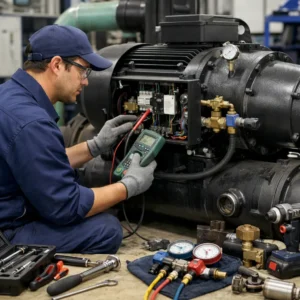
Injection molding production typically operates continuously. Any equipment downtime can cause production interruptions and significant economic losses. Therefore, industrial chillers must offer high reliability, enabling prolonged stable operation and minimizing failure rates. Additionally, chiller designs should facilitate easy maintenance to allow rapid repairs during malfunctions, reducing downtime.
3. Adaptability to Different Plastic Materials
Plastic injection molding involves various materials, each with unique cooling requirements and melting points. For instance, polypropylene (PP) melts at approximately 160°C, while polycarbonate (PC) reaches 287°C. Industrial chillers must flexibly adjust cooling parameters based on material type and production demands to meet diverse cooling needs.
Ⅳ. Key Factors for Selecting Industrial Chillers
1. Cooling Capacity
The primary selection of an industrial chiller is based on its cooling capacity. The greater it is, the higher the efficiency of cooling productivity achieved. The calculation for determining cooling capacity should be based on a thorough assessment that takes into consideration factors such as the melting point of the plastic material, requirements concerning cooling, and time involved in production cycles. Normally, it is expressed that the cooling capacity required to cool a specific weight per hour of plastic varies.
For example, to cool 30 lb/hr high-density polyethylene requires 1-ton cooling capacity; to cool 50 lb/hr acrylonitrile butadiene styrene requires 1 ton also. Batch size and possible future expansion also have to be considered so that the chiller fulfills the requirements for addition as well as for current production.
2. Temperature Control Accuracy
Temperature control precision is critical for the quality of plastic injection molding. Precision injection molding typically requires temperature control accuracy within ±1°C, while standard injection molding can tolerate temperature fluctuations of ±2–3°C.
3. Cooling Medium Selection
The choice of cooling medium depends on multiple factors, including the production environment, space constraints, and cooling efficiency requirements. Water-cooled chillers and air-cooled chillers are two common types of cooling media, each with its own advantages and disadvantages, suitable for different application scenarios.
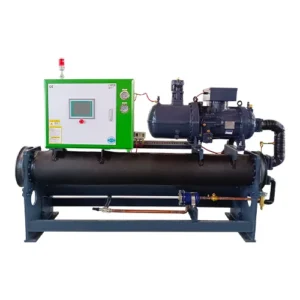
 Water-cooled chillers: Water-cooled chillers send their heat to the air by way of cooling towers. They are very strong at making coolness and energy, thus perfect for large factories where items are made all day long. These chillers run best in spots with a steady supply of water. They fit injection molding that has high needs for cooling. You must, however, mount cooling towers plus setups to clean the water, making the starting price possibly higher as well as more upkeep needed. Also, if the water is not clean, it too must be treated so that blocks do not form inside the system used for cooling.
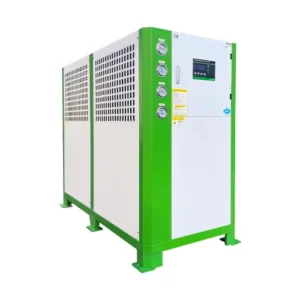
Air-Cooled Chillers: Air-cooled chillers dissipate heat directly into the surrounding air via built-in fans, eliminating the need for cooling towers. These units offer flexible installation and a small footprint, making them particularly suitable for small factories with limited space or requiring mobility. Air-cooled chillers feature relatively low initial investment and simpler maintenance. However, their cooling efficiency is comparatively lower and more susceptible to ambient temperature fluctuations. In high-temperature environments, the heat dissipation performance of air-cooled chillers may decrease, thereby affecting cooling efficiency.
V. Conclusion
The right industrial chiller is extremely important for production efficiency and product quality in the plastic injection molding process. The selection process has to adequately appraise major factors such as cooling capacity, precision of temperature control, choice of cooling medium, reliability and maintenance, plus environmental adaptability. These factors are interdependent with a combined effect on the actual performance of the chiller during real production. Through a precise calculation of cooling requirements, proper selection of cooling media, high equipment reliability, plus adaptability to environmental conditions, an enterprise will gain high production efficiency with low cost, accompanied by consistent product quality.


 English
  Spanish
  Russian
  Portuguese
  French
  Arabic
  Japanese
  German