
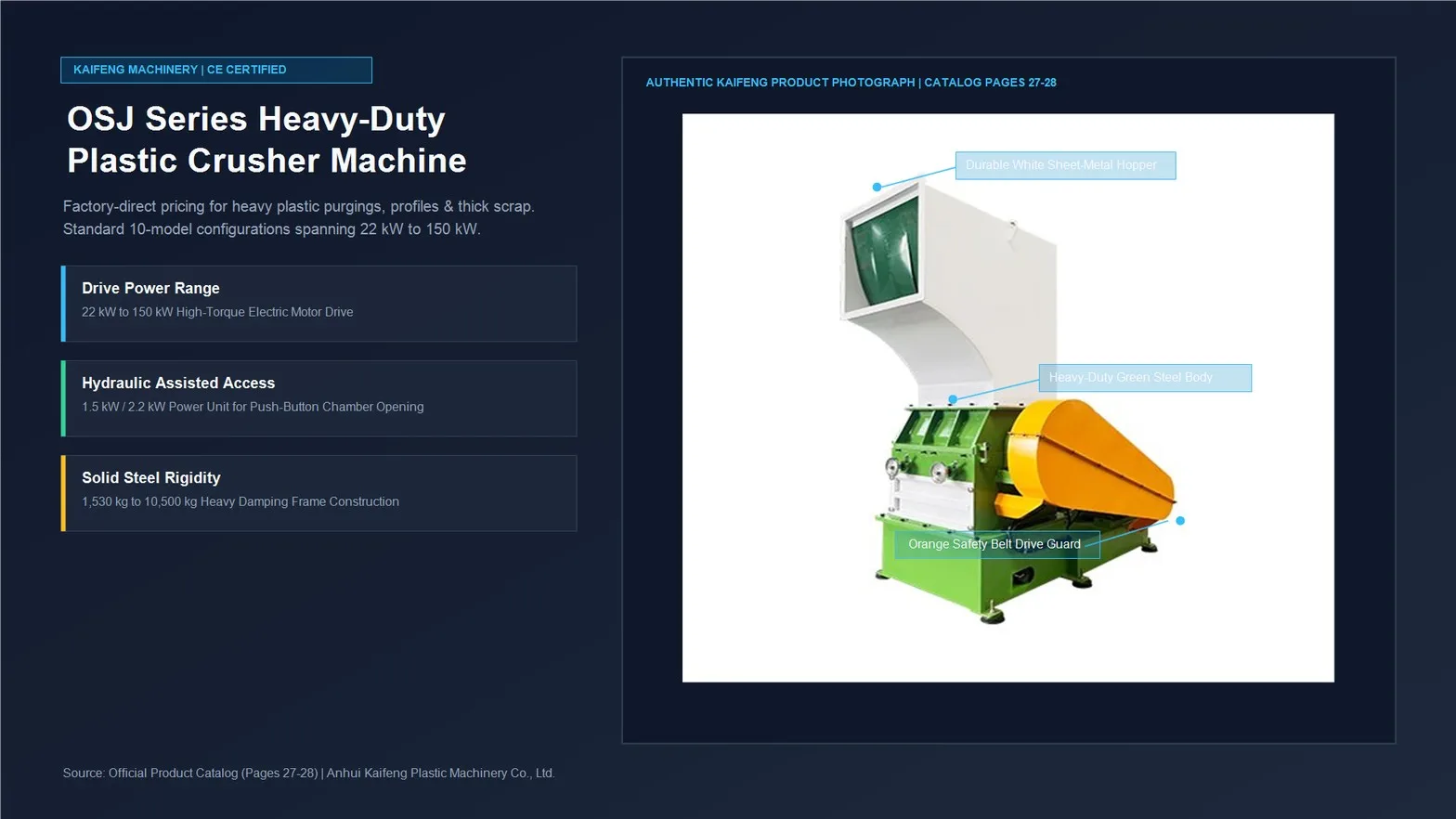
If you are comparing plastic crusher machine prices, the number you see from one supplier rarely matches the number from another – even for what looks like the same machine. That is not because one is overcharging. It is because “a plastic crusher” describes a category, not a specification.
This page explains exactly which variables move the price, using the real specifications of the OSJ series we build. No invented ranges, no fake list prices. The OSJ series is CE certified (2019). By the end you will know which questions to ask any supplier, including us.
Why plastic crushers do not have a single list price
A crusher is configured around your material. Two buyers asking for “a plastic crusher” can end up with machines that differ by a factor of five in motor power, weight and throughput – because one is regrinding thin film and the other is breaking down thick purging blocks.
Publishing one headline price would mean publishing a machine that fits nobody precisely. Instead, every serious manufacturer quotes against four inputs: material type, required output, feed size, and destination.
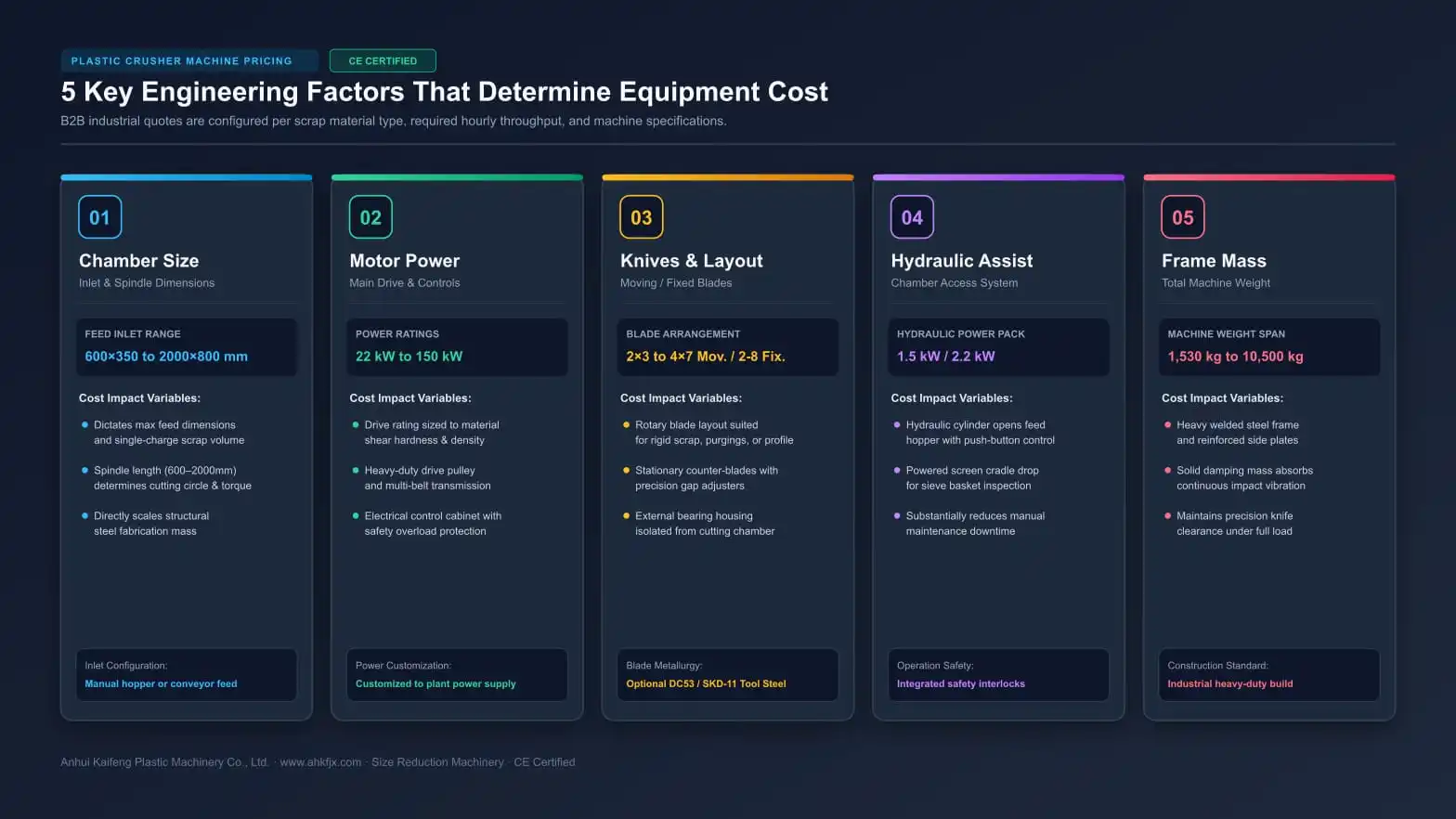
The five variables that move the price
1. Feed opening and crushing chamber
The feed opening sets the largest part that can enter the machine without pre-cutting. It drives the steel weight of the frame and the size of the rotor, and it is one of the biggest single cost factors.
Across the OSJ series the feed opening runs from 600 x 350 mm on the OSJ600 to 2000 x 800 mm on the OSJ2000. Machine weight follows almost linearly: 1,530 kg at the small end, 10,500 kg at the large end.
2. Motor power
Power is chosen from the torque needed to cut your material at your target throughput, not from the throughput number alone.
The OSJ series spans 22/30 kW on the OSJ600 up to 150 kW on the OSJ2000. Where a model lists three figures such as 37/45/55 kW, those are the available power options for the same frame – a larger motor raises both price and energy cost, and only makes sense if your material is genuinely heavy.
3. Rotor and knife configuration
Knife count and arrangement decide what the machine does to the material and how often you stop to sharpen.
Moving knives range from a 2 x 3 arrangement on the OSJ600 to 4 x 7 on the OSJ2000, with fixed knives from 2 to 8. More knives mean faster size reduction and a finer output, but also more wear parts to maintain and a higher purchase price.
4. Hydraulic system and frame
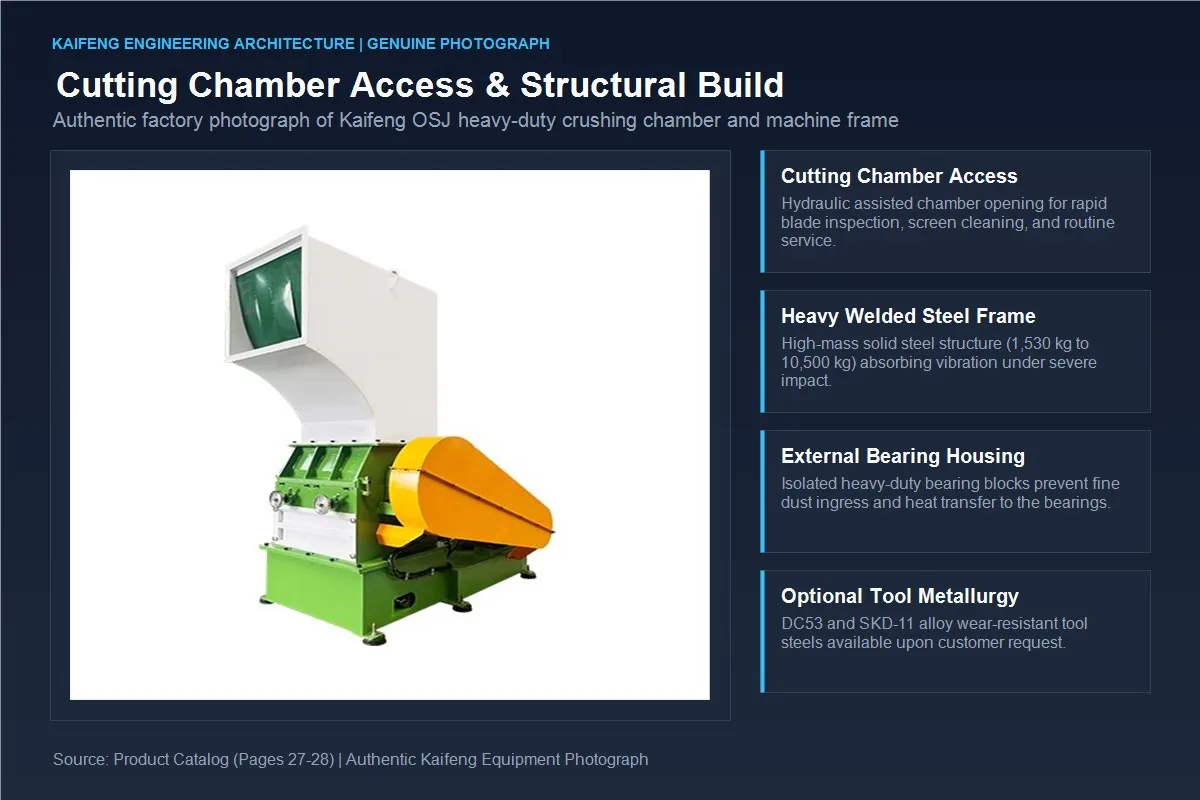
The hydraulic unit opens the chamber for cleaning and knife changes. It is a small share of total cost but a large share of daily usability – a machine without it turns every knife change into a two-hour job.
Hydraulic power across the OSJ series is 1.5 kW on every model up to the OSJ1200, and 2.2 kW on the OSJ1600 and OSJ2000. Frame construction, wall thickness and the welding standard are also part of this line item and are where low-cost copies usually cut corners.
5. Control, safety and wear parts
The electrical package, overload protection, safety interlocks and the steel grade of the knives are all quoted items. Two machines with identical photographs can differ by a substantial margin here alone.
How the OSJ series compares
These are the manufacturer’s published specifications for the OSJ series. Every figure below is as-built data, not an estimate. The series is CE certified.
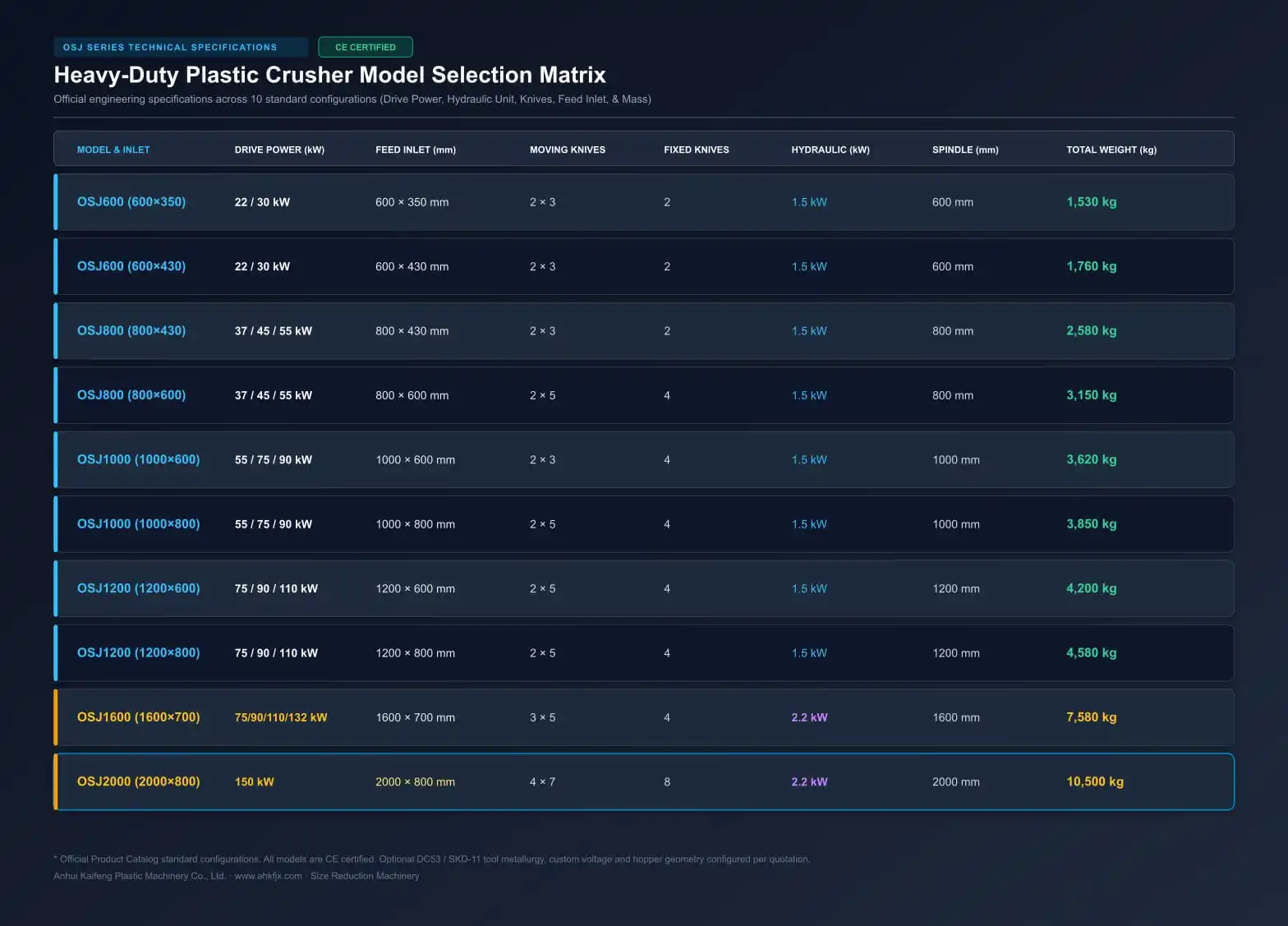
| Model | Power (kW) | Hydraulic power (kW) | Moving knives | Fixed knives | Feed inlet (mm) | Spindle length (mm) | Weight (kg) |
|---|---|---|---|---|---|---|---|
| OSJ600 | 22/30 | 1.5 | 2×3 | 2 | 600 x 350 | 600 | 1,530 |
| OSJ600 | 22/30 | 1.5 | 2×3 | 2 | 600 x 430 | 600 | 1,760 |
| OSJ800 | 37/45/55 | 1.5 | 2×3 | 2 | 800 x 430 | 800 | 2,580 |
| OSJ800 | 37/45/55 | 1.5 | 2×5 | 4 | 800 x 600 | 800 | 3,150 |
| OSJ1000 | 55/75/90 | 1.5 | 2×3 | 4 | 1000 x 600 | 1000 | 3,620 |
| OSJ1000 | 55/75/90 | 1.5 | 2×5 | 4 | 1000 x 800 | 1000 | 3,850 |
| OSJ1200 | 75/90/110 | 1.5 | 2×5 | 4 | 1200 x 600 | 1200 | 4,200 |
| OSJ1200 | 75/90/110 | 1.5 | 2×5 | 4 | 1200 x 800 | 1200 | 4,580 |
| OSJ1600 | 75/90/110/132 | 2.2 | 3×5 | 4 | 1600 x 700 | 1600 | 7,580 |
| OSJ2000 | 150 | 2.2 | 4×7 | 8 | 2000 x 800 | 2000 | 10,500 |
Several models are offered in more than one configuration: the OSJ600 and OSJ800 each appear twice, differing in feed opening and knife count, and the OSJ1000 and OSJ1200 differ in chamber width. Higher power options within a single model do not change the frame – they change available torque.
Crusher or shredder – where the price gap comes from
A crusher and a shredder solve different problems, and the price difference is structural rather than a matter of quality.
A crusher uses a high-speed rotor with moving and fixed knives to reduce material into regrind. It is the right machine when you already have manageable pieces, or when you need granulate for a processing line.
A shredder turns slowly with much higher torque, usually through a gearbox, and takes bulky items whole – drums, purging lumps, woven bags, film bales. Gearboxes, larger rotors and heavier frames are why shredders typically cost more per unit of throughput.
If you are unsure which one fits, describe the material and its largest piece. That single answer usually decides it.
What we need to quote you accurately
Send these four items and we can come back with a real configuration and price instead of a range:
- Material – for example PET bottles, HDPE lumps, PP woven bags, PVC pipe, film, or mixed rigid scrap.
- Required output – kilograms per hour, and whether that is a firm production requirement or a target.
- Largest piece to be fed – length, width and thickness of the biggest item, so the feed opening can be sized correctly.
- Destination – country and nearest port, since voltage, plug standard and freight affect the delivered cost.
Optional but useful: available power supply, whether you need washing or drying downstream, and any floor space limit.
Request a quote: [contact form] | kaifeng@ahkfjx.com | +86-13905569338
We are a manufacturer in Anqing, Anhui Province, China, producing plastic auxiliary equipment including crushers, shredders, chillers, dryers, mixers and feeding systems.
Request a quote
Send material type, required output, largest feed size and destination country. We reply with a specific configuration and price.
Email: kaifeng@ahkfjx.com | Phone: +86-13905569338
Anhui Kaifeng Plastic Machinery Co., Ltd. · No. 9, Xindu Road, Yixiu District, Anqing City, Anhui Province, China
Related: Heavy-duty plastic crusher · Plastic shredder specifications · All plastic auxiliary equipment · Contact us
FAQ
How much does a plastic crusher machine cost?
There is no fixed price, because a crusher is built around your material. The five variables above – feed opening, motor power, knife configuration, hydraulic system and frame, and the electrical and wear-part package – move the price substantially. A 22 kW OSJ600 weighing 1,530 kg and a 150 kW OSJ2000 weighing 10,500 kg are both “plastic crushers”, and they are not in the same price bracket. Send your material, target output, largest piece size and destination, and you will get a specific configuration and price.
Why is there no price listed on this page?
Because a published price would have to assume a material, a throughput and a destination that probably do not match yours. Quoting against one invented configuration wastes your time and ours. We quote against your four inputs instead.
What is the difference between the 37, 45 and 55 kW options on the OSJ800?
They are three motor options for the same frame and feed opening. Higher power gives more torque for denser or tougher material and a higher energy cost in operation. If your material is thin film or light regrind, the smaller motor is usually sufficient; if it is thick purging or dense lumps, the larger one prevents stalling.
Should I buy a crusher or a shredder?
Choose a crusher when your material is already in pieces you can lift and feed, and you want regrind output. Choose a shredder when the material arrives bulky – drums, bales, large lumps – and needs reducing before it can be granulated. Many recycling lines use both: a shredder first, then a crusher.
 English
 Spanish
 Russian
 Portuguese
 French
 Arabic
 Japanese
 German