
Air cooled chillers tend to look similar at first glance, but the compressor type changes quite a lot under the hood. That difference affects capacity, efficiency, noise, maintenance, and even where the unit makes sense to install. In practice, the decision is rarely about one “best” model; it’s more about matching the system to the load, the building, and the operating pattern.
For facilities that need reliable process cooling or comfort cooling without the complexity of a cooling tower, чиллер с воздушным охлаждением systems remain a very practical choice. They are widely used because they simplify installation and reduce water dependency, which is often a deciding factor in real-world projects.

What Are Air Cooled Chillers?
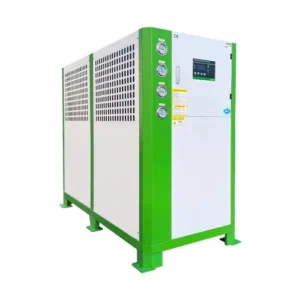
At a basic level, air cooled chillers remove heat from water or another fluid and reject that heat into the surrounding air. Instead of relying on a cooling tower and condenser water loop, they use fans and ambient air to get the job done. That makes them easier to site, easier to maintain in some cases, and generally less dependent on water infrastructure.
They show up in all sorts of settings:
- Manufacturing plants
- Food and beverage processing lines
- Plastic injection molding
- Data centers
- Commercial buildings
- Pharmaceutical facilities
Хороший Промышленный чиллер often comes down to selecting the right cooling architecture for the environment, and air cooled units are frequently chosen when simplicity and flexibility matter more than peak water-side efficiency.
The Main Types of Air Cooled Chillers
The compressor is really where the personality of the chiller starts to show. Scroll, screw, and centrifugal chillers each serve a different kind of cooling demand.
1. Scroll Air Cooled Chillers
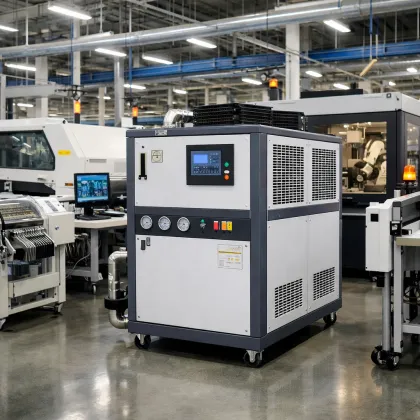
Scroll chillers use scroll compressors, which compress refrigerant through two interleaved spiral elements. The design is compact and relatively quiet, and it has a reputation for stable, dependable operation.
These units are usually a strong fit for small to medium cooling loads. That could mean a lab, a mid-sized workshop, a commercial building, or a process line that doesn’t need huge tonnage. They are often selected because they are straightforward, efficient at moderate capacities, and less intimidating from a maintenance standpoint.
Common strengths include:
- Compact footprint
- Lower noise compared with some larger systems
- Good efficiency at smaller loads
- Simple operation
The tradeoff is that scroll chillers are not usually the first choice for very large installations. Once cooling demands climb significantly, other compressor types tend to make more sense.
2. Screw Air Cooled Chillers
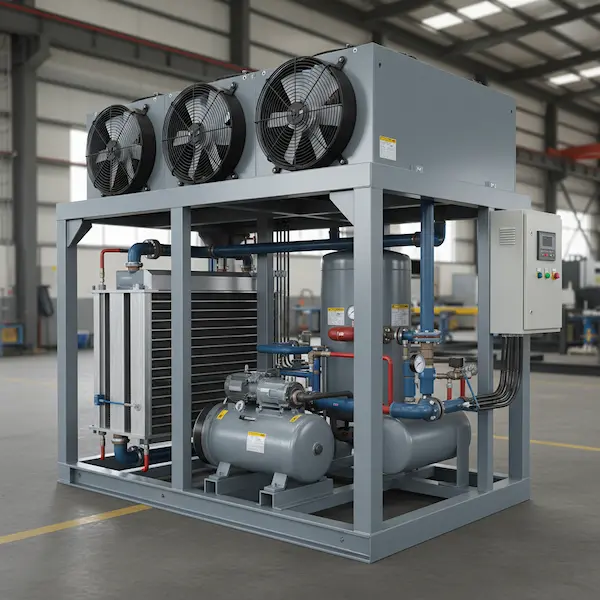
Screw chillers use a pair of intermeshing rotors to compress refrigerant. The design is robust and handles larger capacities more comfortably than scroll systems. In industrial settings, that matters quite a bit.
A screw compressor can often support changing demand better than expected, especially in facilities where load fluctuates across shifts or seasons. That is one reason Industrial Chiller projects frequently use screw-based systems. They offer a balance of scale, efficiency, and durability that suits heavier-duty operations.
Screw chillers are typically valued for:
- Better performance at larger cooling loads
- Good part-load efficiency
- Long service life
- Flexibility across industrial applications
They do come with a higher upfront cost in many cases, and the system is a bit more complex than a scroll unit. Still, for facilities that need dependable cooling over long operating hours, that investment can make sense.
3. Centrifugal Air Cooled Chillers
Centrifugal chillers work differently again. Instead of squeezing refrigerant through screws or scrolls, they use a high-speed impeller to accelerate vapor and convert that energy into pressure. It sounds a little dramatic, and in a way it is — these systems are built for major cooling demands.
They are best suited for large-scale projects where capacity matters more than compactness. Hospitals, large campuses, major commercial towers, and some heavy industrial sites may use centrifugal chillers when the load justifies it.
Their advantages usually include:
- Very high cooling capacity
- Strong performance in large systems
- Efficient operation at scale
- Suitable for centralized cooling plants
The downside is that they are usually overkill for smaller facilities. They also tend to be more specialized, so they are not the simplest answer for every project.
Scroll, Screw, and Centrifugal: Quick Comparison
| Тип охладителя | est For | Capacity Range | Уровень шума | Сложность обслуживания | Typical Use |
|---|---|---|---|---|---|
| Прокрутка | Small to medium loads | Нижний | Low to moderate | Низкий | Commercial spaces, light industrial use |
| Винт | Medium to large loads | Medium to high | Умеренный | Умеренный | Industrial processes, continuous-duty applications |
| Центробежный | Very large loads | High to very high | Умеренный | Higher | Large campuses, central plants, major facilities |
This comparison only tells part of the story, of course. Site conditions, ambient temperature, runtime, and future expansion plans can shift the decision more than expected.
How to Choose the Right Air Cooled Chiller
The most reliable way to narrow the field is to start with the load profile, not just the nameplate capacity. A chiller that looks ideal on paper may be a poor fit if the real operating pattern is uneven.
A few practical factors usually matter most:
- Cooling load size: Small loads often suit scroll chillers, while larger systems may call for screw or centrifugal units.
- Available space: Rooftop or tight-site installations often favor compact equipment.
- Energy goals: Part-load performance can matter more than peak efficiency.
- Maintenance resources: Simpler systems may be easier to support with limited technical staff.
- Budget: Initial cost and lifecycle cost do not always point to the same model.
In some projects, an air cooled unit is the obvious choice. In others, a винтовой чиллер с водяным охлаждением may be evaluated instead, especially where water availability, efficiency targets, or large continuous loads change the equation. That comparison is worth making early rather than late.
Заключение
Choosing the right air cooled chiller comes down to matching the compressor type to your actual cooling load: scroll chillers are ideal for small to medium loads in commercial buildings, labs, and light industrial settings thanks to their compact design and low maintenance; screw chillers handle medium to large loads with excellent part-load efficiency, making them the go-to choice for continuous industrial operations like manufacturing and food processing; and centrifugal chillers deliver very high capacity for large-scale projects such as hospitals, campuses, and central plants, though they are overkill for smaller facilities. Across all three types, air cooled chillers simplify your project by eliminating cooling towers and reducing water dependency — which means faster installation, lower maintenance, and fewer components to manage. Still unsure which type fits your facility? Start with your load profile — not just peak demand, but how it behaves across shifts and seasons — then consider your space, ambient temperature, and maintenance resources. We are here to help: contact us for a free load assessment, request a quote for a tailored recommendation, or browse our collection to compare scroll, screw, and centrifugal models side by side.
If you want to learn more about Air Cooled Chillers,you can read Как чиллеры с воздушным охлаждением отводят тепло?
ЧАСТО ЗАДАВАЕМЫЕ ВОПРОСЫ
Are air cooled chillers harder to maintain in dusty environments?
Not necessarily, but airborne dust can affect coil performance and fan operation. In harsher environments, regular cleaning and a thoughtful placement strategy become especially important.
Which chiller type handles variable production schedules best?
Screw chillers are often a strong candidate when demand rises and falls throughout the day, since they tend to manage part-load conditions well.
Can air cooled chillers be used in warm climates?
Yes, but ambient temperature does influence performance. Proper sizing and selection become more important when summer heat pushes the system closer to its operating limits.

 Russian
  English
  Spanish
  Portuguese
  French
  Arabic
  Japanese
  German