
Most shredder enquiries fail on the same point: the buyer compares capacity figures from two suppliers without knowing that capacity depends on the material being shredded, not only on the machine. This page publishes the full specification tables for both shredder series we build, with every field defined, so you can compare like with like.
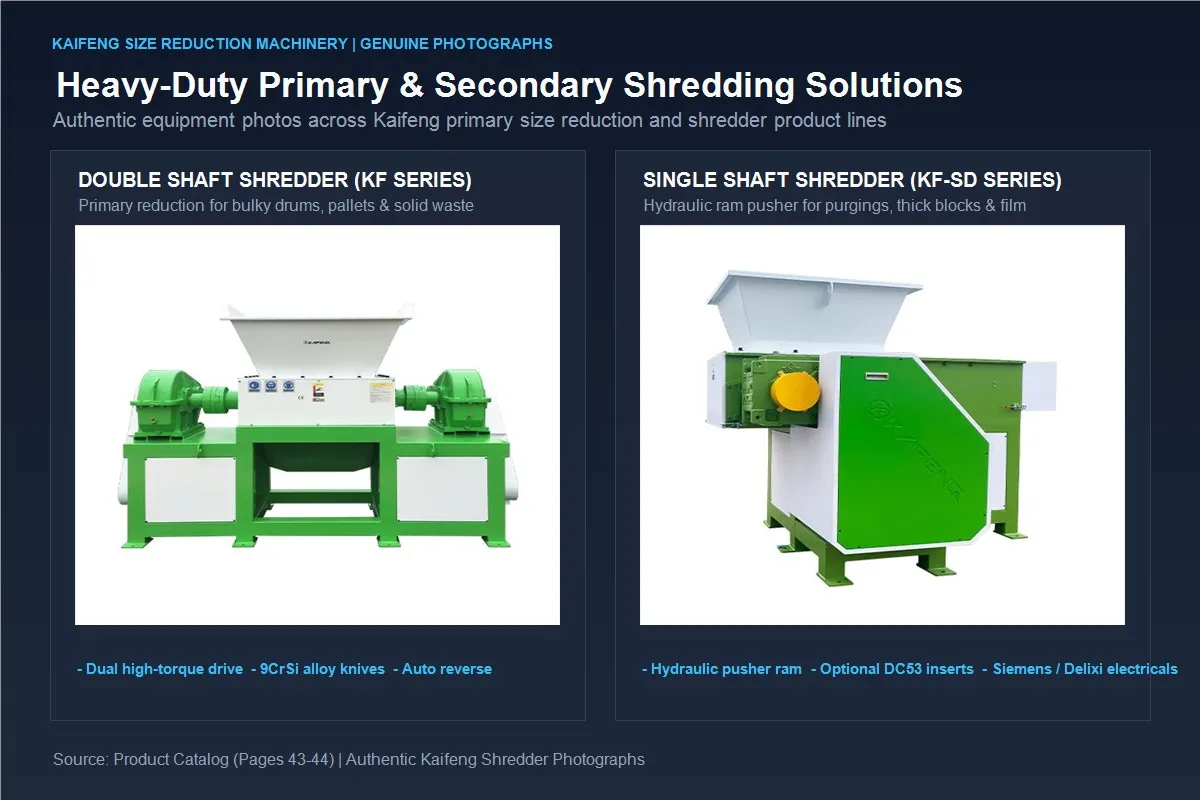
Two series are covered here: the KF double-shaft series and the KF-SD dual single-shaft series.
Shredders are built for large, solid, thick-walled plastic: purging blocks, heavy-wall sections and big hollow bodies that a high-speed crusher cannot grip or shear. The rotors turn slowly with very high torque and tear the material apart, and the output is a coarse shred rather than a fine regrind.
If your scrap is regular moulded or extruded product – runners, pipes, profiles, sheet, bottles, boxes, packaging – you need a crusher, not a shredder. The crusher price guide covers that range, including the blade types used for each material.
How to read these tables
| Field | What it actually tells you |
|---|---|
| Blade size | The cutting edge dimension. Larger blades take larger pieces but produce coarser output. |
| Inlet size | The opening material falls into. It caps the largest item you can feed without pre-cutting. |
| Capacidad | Throughput in kg/h. Material dependent – always quoted against a specific material, never as a universal guarantee. |
| Potencia | Motor rating. Higher power means more torque for denser material, and higher running cost. |
| Número de cuchillas | Total cutting edges. More blades give faster size reduction and more wear parts. |
| Rotor diameter | Larger rotors carry more inertia and handle bulkier feed. |
| Velocidad | Rotor speed in r/min. Lower speed with higher torque is the shredder signature. |
| Screen aperture | Fixed screen under the rotor. It sets the maximum output particle size. |
KF double-shaft shredder series
Both shafts carry blades and turn at low speed. See the double-shaft shredder product page for applications. The blade material across the series is 9CrSi, rotor speed 83 r/min, and screen aperture 100 mm.
| Modelo | Tamaño de la cuchilla (mm) | Tamaño de la entrada (mm) | Capacity (kg/h) | Potencia (kW) | Cuchillas | Rotor dia. (mm) |
|---|---|---|---|---|---|---|
| KF-600 | 300 | 690 x 500 | 400-600 | 11 | 10×2 | 280 |
| KF-600 | 300 | 690 x 500 | 400-600 | 15 | 10×2 | 280 |
| KF-600 | 300 | 690 x 500 | 400-600 | 18.5 | 10×2 | 280 |
| KF-800 | 300 | 900 x 900 | 800-1000 | 22 | 10×2 | 400 |
| KF-800 | 400 | 900 x 900 | 800-1000 | 30 | 10×2 | 400 |
| KF-800 | 400 | 900 x 900 | 800-1000 | 37 | 10×2 | 400 |
| KF-1000 | 400 | 1000 x 1200 | 1000-1200 | 45 | 12×2 | 400 |
| KF-1000 | 450 | 1000 x 1200 | 1000-1200 | 45 | 12×2 | 400 |
| KF-1000 | 450 | 1000 x 1200 | 1000-1200 | 55 | 12×2 | 400 |
| KF-1200 | 400 | 1200 x 1500 | 1200-1500 | 55 | 15×2 | 420 |
| KF-1200 | 450 | 1200 x 1500 | 1200-1500 | 55 | 15×2 | 420 |
| KF-1200 | 500 | 1200 x 1500 | 1200-1500 | 55 | 15×2 | 420 |
| KF-1200 | 500 | 1200 x 1500 | 1200-1500 | 75 | 15×2 | 420 |
| KF-1400 | 400 | 1500 x 1600 | 1500-1800 | 55 | 17×2 | 420 |
| KF-1400 | 450 | 1500 x 1600 | 1500-1800 | 55 | 17×2 | 420 |
| KF-1400 | 500 | 1500 x 1600 | 1500-1800 | 75 | 17×2 | 420 |
Rows sharing a model differ in blade size and motor rating, not in frame. Where the same blade and power combination appears twice for a model, two frame builds are published with different overall weights – ask us which one applies to your material.
Blade material: 9CrSi across all models. Apertura de pantalla: 100 mm.
KF-SD dual single-shaft shredder series
Two single-shaft rotors run side by side (see the dual single-shaft shredder), each on its own motor – which is why power is listed as a pair such as 22×2. Each shaft combines fixed and rotating knives.
| Model (shaft L x W, mm) | Output (kg/h) | Fixed knife | Rotating knife | Rotor dia. (mm) | Spindle speed (r/min) | Potencia (kW) | Approx. weight (kg) |
|---|---|---|---|---|---|---|---|
| KF-SD600 (560 x 680) | 150-200 | 2 | 40×2 | 340 | 80 | 22×2 | 2,500 |
| KF-SD800 (460 x 800) | 500-800 (tonelada saco) | 2 | 56×2 | 400 | 80 | 37×2 | 4,000 |
| KF-SD1000 (960 x 1000) | 350-400 | 4 | 68×2 | 400 | 80 | 55×2 | 5,100 |
| KF-SD1200 (1160 x 1200) | 450-500 | 8 | 84×2 | 420 | 80 | 75×2 | 7,000 |
| KF-SD1300 (1160 x 1200) | 600-800 | 8 | 88×2 | 420 | 80 | 75×2 | 7,500 |
| KF-SD1500 (1460 x 1500) | 800-1000 | 8 | 104×2 | 420 | 80 | 90×2 | 8,000 |
Shared specification across the series: gearbox Tongli, control system PLC Xinling / Mitsubishi, electrical brand Delixi / Siemens, blade material DC53, screen holes 120 mm x 2 per machine.
One reading note: the KF-SD800 output figure of 500-800 kg/h refers to ton-bag processing, which is low-density material. It is not directly comparable with the figures for the 1000, 1200 and 1300 models, which are quoted on denser feed. This is exactly why capacity needs a material attached to it.
Which specification matters most
For most buyers the decision order is:
- Inlet size – if it cannot take your largest piece, nothing else matters. Measure the biggest drum, lump or bale you intend to feed.
- Capacidad – but read it as “kg/h for material X”. Ask any supplier which material the figure was measured on.
- Potencia – the torque reserve for your material. Too little and the machine stalls under load; too much and you pay for energy you do not use.
- Rotor diameter and blade count – these set output size and maintenance interval together with the screen.
- Screen aperture – the one specification you can change to trade output size against throughput.
Matching a shredder to your material
| Material | What to look at first | Why |
|---|---|---|
| Film, thin bags | Inlet width and blade geometry | Light material needs volume, not torque; a narrow inlet bridges. |
| Woven / ton bags | Inlet size and rotating knife count | Bags wrap around rotors; more rotating knives cut them free. |
| Drums, barrels | Inlet size and rotor diameter | The whole item must enter; rotor inertia carries the cut. |
| Purging, thick lumps | Power and blade size | Dense material needs torque and a heavy cutting edge. |
| Pipe, profiles | Inlet length and spindle length | Long sections need axial room, not just a wide opening. |
Request a quote
Send material type, required output, largest feed size and destination country. We reply with a specific configuration and price.
Correo electrónico: kaifeng@ahkfjx.com | Phone: +86-13905569338
Anhui Kaifeng Plastic Machinery Co., Ltd. · No. 9, Xindu Road, Yixiu District, Anqing City, Anhui Province, China
Related: Plastic crusher machine price · Trituradora de doble eje · Dual single-shaft shredder · Póngase en contacto con nosotros
Certification and compliance
The Kaifeng range has held EU CE certification since 2019, covering the size-reduction and shredding lines as well as the temperature-control and material-handling equipment. Certification documents are issued with each shipment and can be supplied in advance for tender or customs purposes.
Electrical components are sourced from Delixi and Siemens; PLC control is configured with Xinling or Mitsubishi controllers depending on the model. State your destination market when requesting a quote so the correct voltage and certification package is quoted.
PREGUNTAS FRECUENTES
What is the difference between a double-shaft and a dual single-shaft shredder?
A double-shaft machine has two counter-rotating shafts carrying blades, listed here with a single motor rating and blade counts such as 10×2. A dual single-shaft machine runs two single-shaft rotors side by side, each with its own motor – shown as 22×2, 37×2 and so on – and combines separate fixed and rotating knives on each shaft. Double-shaft machines are the usual choice for bulk reduction; dual single-shaft machines suit applications needing more cutting action per pass.
Why do the capacity figures not increase in a straight line across models?
Because capacity is quoted per material. The KF-SD800 figure of 500-800 kg/h refers to ton bags, which are low density; the KF-SD1000 figure of 350-400 kg/h is quoted on denser feed. A higher number does not mean a stronger machine – it means lighter material.
What does the screen aperture control?
The fixed screen under the rotor sets the maximum particle size that leaves the machine. A smaller aperture gives finer output at lower throughput; a larger aperture gives more throughput at coarser output. KF series machines are listed with a 100 mm screen, KF-SD series with 120 mm screens, two per machine.
Can these machines be customised?
Power options, blade size and frame build already vary within each model as shown in the tables. Beyond that, voltage, plug standard and discharge configuration are normally specified per destination. Provide your material, target output, largest feed size and destination for a configuration and quote.
 Spanish
 English
 Russian
 Portuguese
 French
 Arabic
 Japanese
 German