

A plastic bottle crusher machine – also listed as a plastic bottle crushing machine or a PET bottle crusher – turns used PET and HDPE bottles into uniform flakes that can be washed, dried and sold as regrind. The correct machine class for bottles is a flat-blade granulator, not a shredder: bottles are thin-walled hollow parts, and they shear cleanly at high rotor speed instead of needing to be torn apart.
This page covers the nine PD flat-blade models we build, from 7.5 kW to 75 kW, with the real chamber dimensions, throughput and weights taken from our own catalogue data. It also explains why a large share of buyers who search for a “bottle shredder” end up with the wrong machine, and how to size the right one from your tonnage rather than from a guess.
What a bottle crusher actually does
Inside a flat-blade crusher the rotor carries 3 to 9 moving blades, matched against 2 to 4 fixed bed blades. The clearance between the two sets is set during assembly and is what separates cutting from tearing: material is trapped in the gap and sheared, producing flakes with a fairly even edge rather than crushed fragments and dust.
The PD rotor carries straight, flat knife bars bolted onto a square-section body, running against fixed bed blades. Because the cutting edge is dead straight and spans the full width of the chamber, a bottle cannot roll away from it: the wall is drawn into the gap along its whole length instead of being caught at a single point. That is what keeps the flake uniform and the powder fraction down. Powder is the material you cannot sell, so less of it means a better yield from the same input weight.
Depending on model, the discharge is either gravity-fed into a bin or pulled through a fan into a cyclone and collection bag. Bottles arriving baled or with residual liquid are usually de-baled and drained first, because a crusher is a size-reduction device, not a washing device. What comes out is a flake product; what happens to that flake afterwards – washing, friction washing, dewatering, drying – is a separate stage of the line. Buyers who call this stage a bottle grinder, or a PET bottle crushing station, are describing the same operation: the difference in wording is regional habit, not a difference in equipment.
Bottle crusher or bottle shredder: which one bottles need
A large share of buyers arrive here after searching for a plastic bottle shredder. The terminology is genuinely confusing, and the two machine classes solve different problems, so this section is worth reading before you compare quotations.
A shredder runs a slow, high-torque rotor with hooks or large teeth. It is built for objects that cannot be fed into a crusher at all: solid thick-walled purging blocks, large lumps, whole bales, heavy-walled pipe, tyres. It tears material into coarse chunks, and those chunks normally still need a second pass through a granulator before they can be sold. Slow speed is the point – it gives the torque to bite into a solid mass without stalling.
A trituradora runs a fast rotor with sharp blades against fixed bed blades. It is built for material that is already thin: injection moulded parts, extruded profile, sheet, film, and hollow bodies. A PET bottle is the textbook case – roughly 25 g of material spread over a large surface, with almost no wall thickness. A slow high-torque rotor has nothing solid to bite into. It will flatten the bottle, push it around the chamber and generate heat and fines, while a fast sharp rotor cuts it into consistent flake in a single pass.
That is why bottle lines are built around granulators. Where a shredder does appear in a bottle plant, it is usually upstream – opening whole bales or reducing pre-sorted rigid rejects – and it feeds a crusher rather than replacing it. If your material is genuinely a solid thick-walled lump rather than a bottle, you want the plastic shredder specifications page instead, because none of the nine models below is the right tool for it.
The PD flat-blade series: nine models, 7.5 kW to 75 kW
The PD range is our bottle and hollow-part series. All nine models share the same architecture – welded steel frame, flat-blade rotor, interchangeable screen – and differ in chamber size, rotor blade count, motor power and weight. The table below is the catalogue data, unmodified.
| Modelo | Potencia (kW) | Moving blades | Fixed blades | Crushing chamber (mm) | Capacity (kg/h) | L × W × H (mm) | Weight (kg) |
|---|---|---|---|---|---|---|---|
| PD400 | 7.5 | 3 | 2 | 415 × 230 | 200–300 | 1200 × 850 × 1340 | 515 |
| PD500 | 11 / 15 | 3 / 6 | 2 | 515 × 295 | 300–400 | 1435 × 1100 × 1550 | 900 |
| PD600 | 15 / 22 / 30 | 6 | 2 | 615 × 320 | 350–450 | 1580 × 1100 × 1650 | 1050 |
| PD700 | 15 / 22 / 30 | 6 | 2 | 715 × 320 | 400–500 | 1610 × 1210 × 1740 | 1400 |
| PD800 | 22 / 30 / 37 / 45 | 6 / 9 | 4 | 825 × 470 | 450–600 | 1750 × 1950 × 2340 | 2000 |
| PD960 | 37 / 45 / 55 / 75 | 9 | 4 | 960 × 600 | 600–800 | 1800 × 2000 × 2700 | 3000 |
| PD1000 | 30 / 37 / 45 | 9 | 4 | 1025 × 470 | 600–700 | 2000 × 2150 × 2340 | 2500 |
| PD1100 | 55 / 75 | 9 | 4 | 1100 × 600 | 800–1000 | 2550 × 2250 × 3400 | 4600 |
| PD1200 | 55 / 75 | 9 | 4 | 1200 × 600 | 1000–1500 | 2050 × 2250 × 3010 | 5000 |
Two things in that table are worth understanding before you pick a row. First, where two or three power figures are listed, the lower one is the standard motor and the higher ones are options – the chamber and rotor stay the same, so the decision is about whether your material is easy (thin-walled, clean, pre-crushed) or harder (thicker HDPE, denser preforms, high throughput per hour). Second, capacity is quoted in kilograms per hour of output, not bottles. Converting between the two is the subject of the sizing section below.

All models in the range carry CE safety certification, and all share the same service access: the hopper and upper chamber lift or swing away so the rotor, blades and screen can be reached without dismantling the frame.
Why flat blades, not claw or V blades
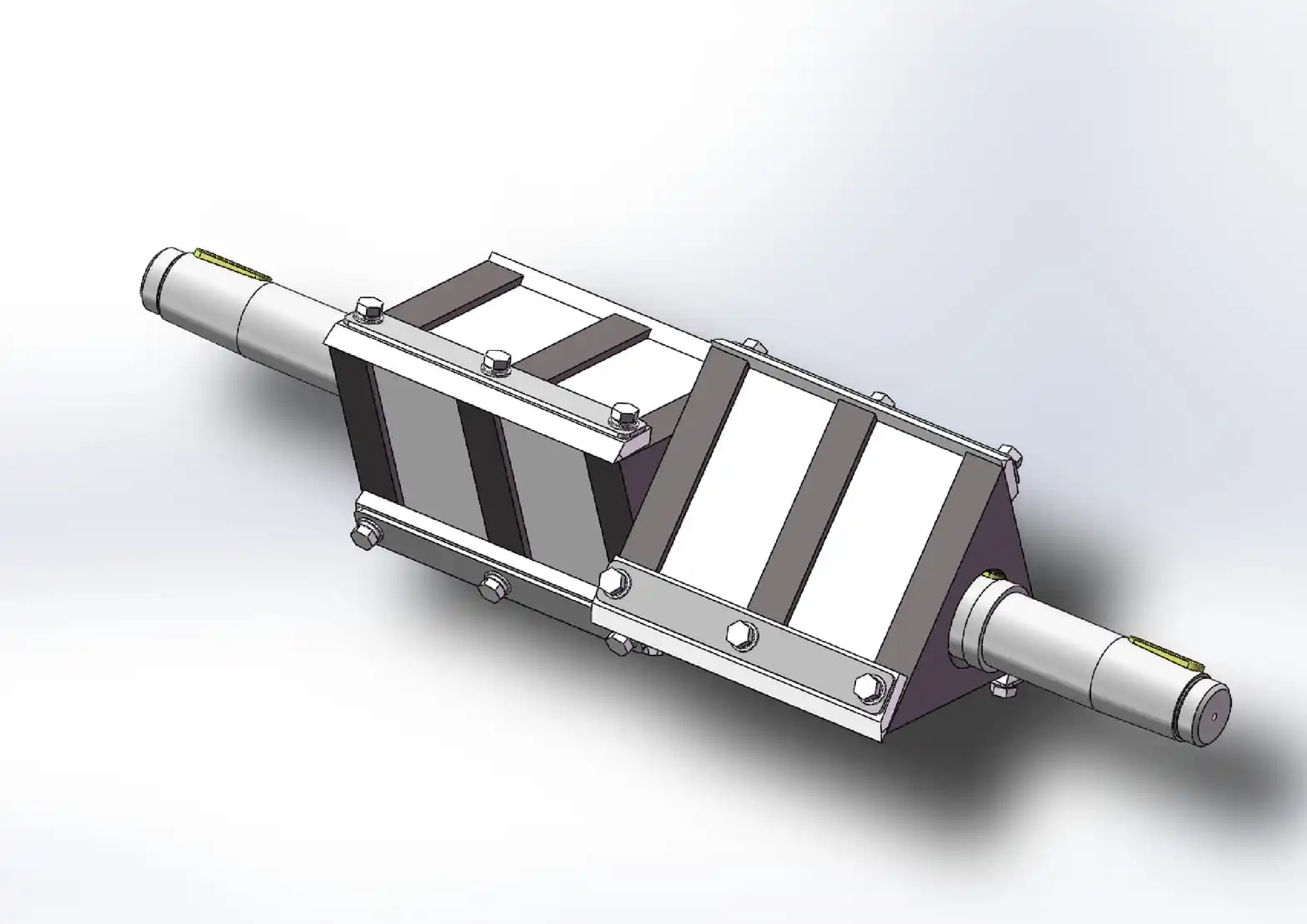
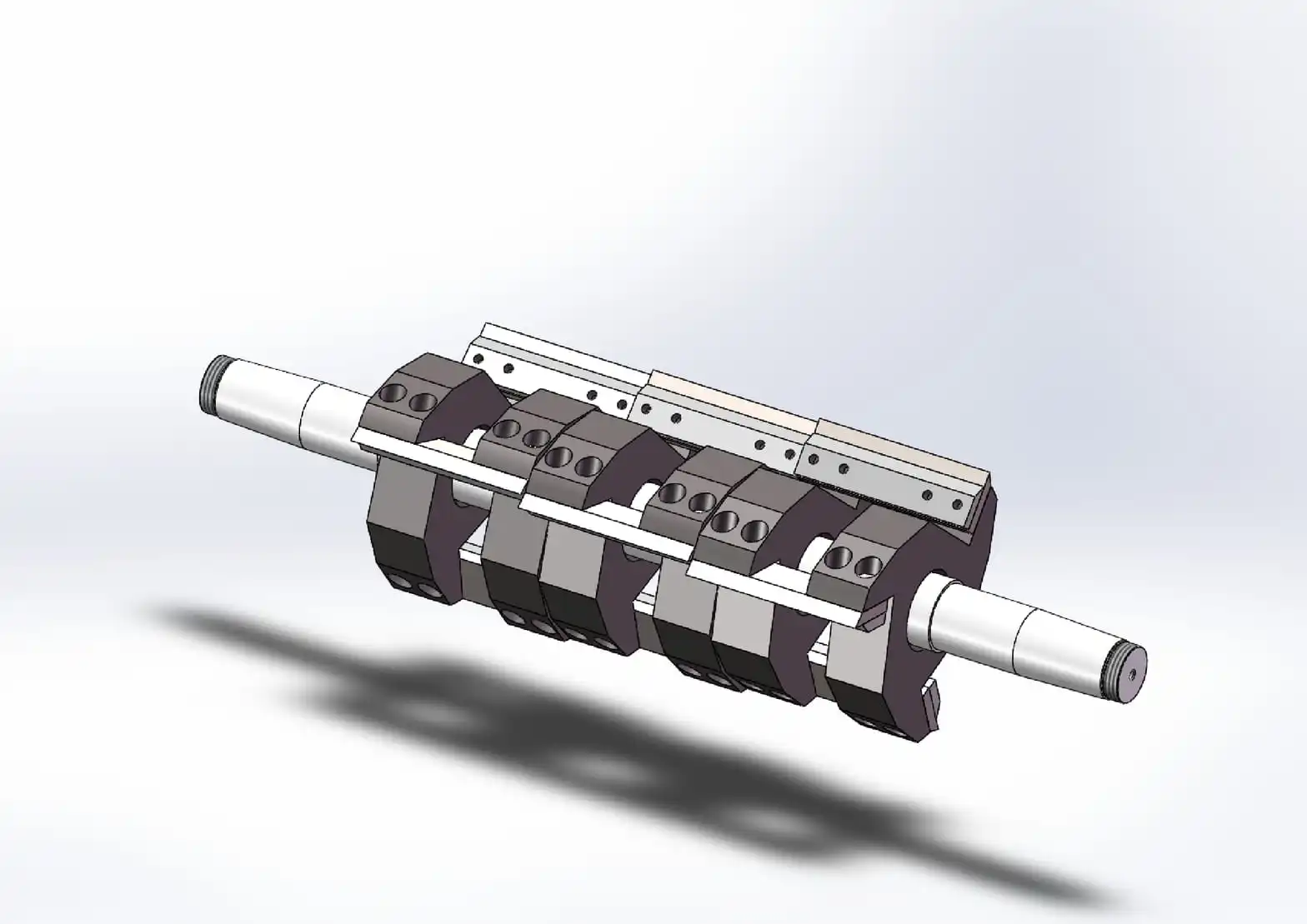
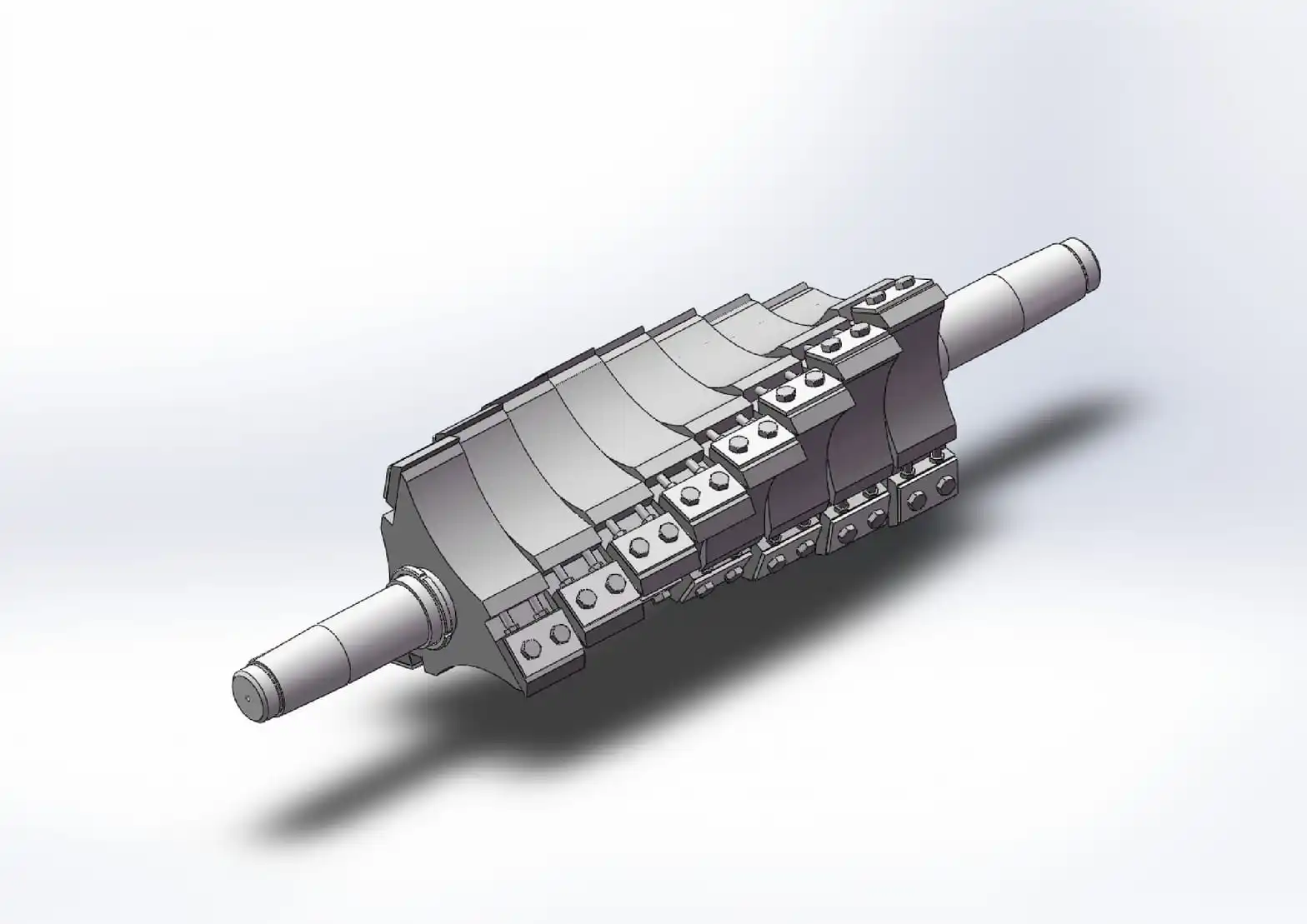
We build four blade geometries for different feedstocks, and the differences are not cosmetic – each one is a different way of presenting material to the cut.
Rotor assemblies as built in our workshop, one per blade geometry:
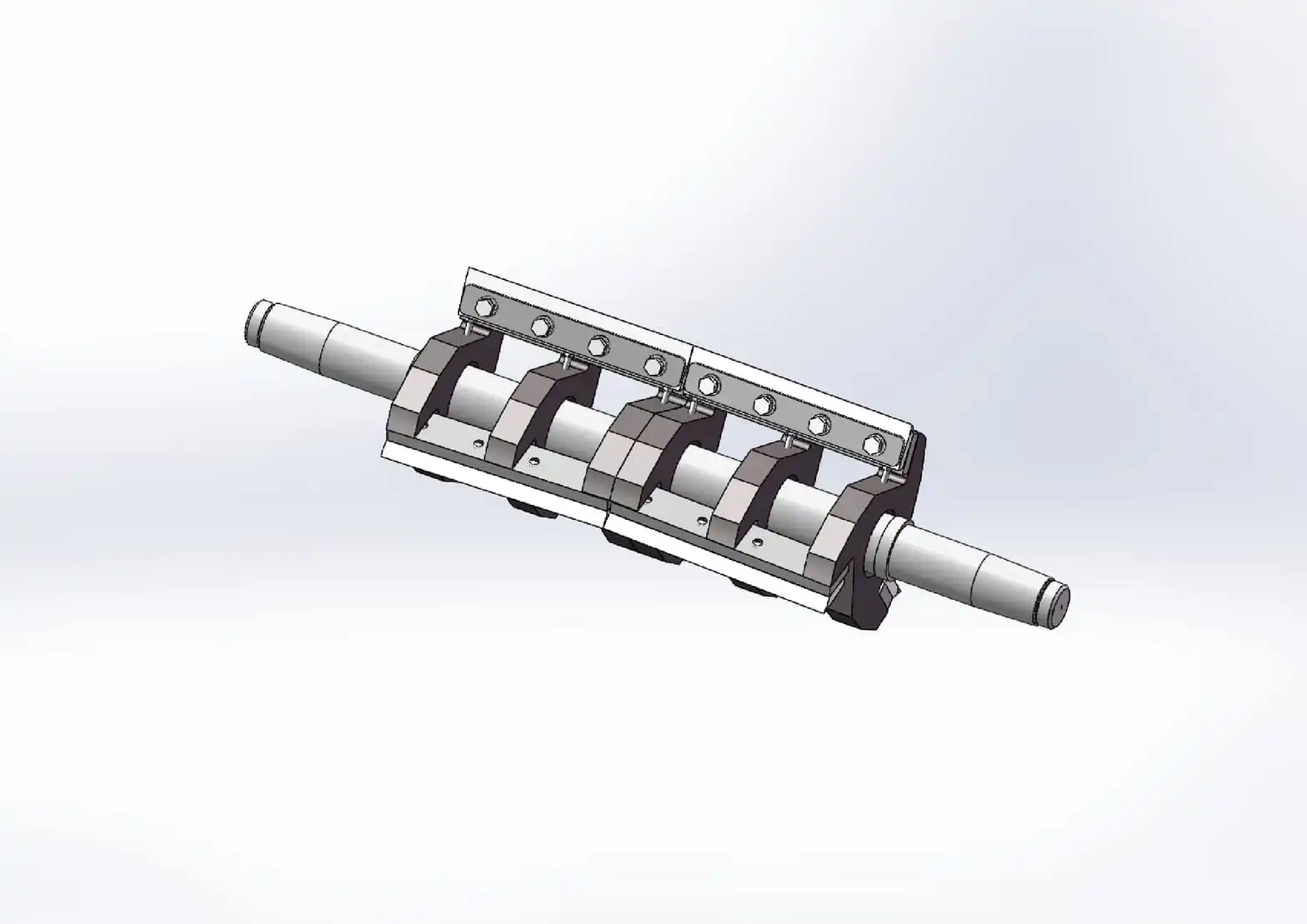
Flat blade is the bottle geometry. A flat knife mounted on a wide rotor body presents a long, straight cutting edge to the material and pulls thin-walled hollow parts into the gap rather than pushing them along the chamber. It is the configuration we recommend for PET bottles, HDPE bottles, blow moulded containers, thin pipe and shells.
Claw blade – the hooked segments shown second above – suits hard, thick sections – crate material, shoe soles, lump stock. The hooked profile grabs bulkier pieces and holds them while the cut completes, which flat blades do less well on thick material.
V blade is for film, woven bag and large hollow products where the material tends to slip sideways; the V profile centres the material on the rotor so it cannot slide off the cutting edge.
Slice blade sits between claw and flat and handles ordinary sheet, pipe, profile, plate and packaging – a general-purpose geometry rather than one tuned for a single feedstock.
Blade material matters as much as geometry. Standard knives are imported tool steel; SKD-11 and DC53 are available as an option and hold an edge longer on abrasive or glass-filled material. On a bottle line running clean PET, standard tool steel is normally sufficient – the wear in that line comes from grit and label residue rather than from the plastic itself, which is one more argument for washing before crushing rather than after.
Screen aperture decides what you can sell
The screen under the rotor is the only component that sets the maximum flake size, and it is interchangeable. Fit a tight screen and you get fine, dense flake that dewaters and dries faster and packs more weight per bag; fit an open screen and you get throughput back, at the cost of a coarser product that some buyers will reject.
There is no universal correct aperture, because the answer depends on who buys your flake. A converter feeding an injection press wants a consistent, small flake that melts evenly. A regrind trader selling on specification wants a declared size band and low fines. A densifying operation downstream may be less sensitive to size and more sensitive to throughput.
The practical approach is to decide the target flake size first, then let the screen follow, and to treat throughput as the variable that moves. A machine rated at 600–800 kg/h will not deliver the top of that range through the tightest screen – the screen, not the motor, becomes the constraint. Because the screen is a wear part that is replaced anyway, the sensible way to commission a new line is to order a small set of apertures and measure your own yield across them rather than to accept one screen and never change it.
Screens with different cutter and aperture combinations are selectable on every PD model, and the change is a service task rather than a rebuild.
Sizing the machine from your tonnage
The most common sizing error is starting from motor power. Work backwards from the material instead: how many kilograms per hour do you actually need to get through, and over how many hours per day.
Take a collection operation handling 2 tonnes of bottles per shift of 8 productive hours. That is 250 kg/h of input, which lands inside the PD400’s 200–300 kg/h band. A line running 5 tonnes per 8-hour shift needs 625 kg/h and lands in the PD960’s 600–800 kg/h band. A plant at 10 tonnes per shift needs 1,250 kg/h, which is PD1200 territory. Real throughput drops when the material is wet, heavily labelled, or fed unevenly, so it is normal to size one step above the calculated figure when the feed is inconsistent.
To convert bottle counts into weight, use your own bale weights rather than a rule of thumb. As a working reference, a typical 500 ml PET bottle weighs around 25 g, so 1,000 kg/h corresponds to roughly 40,000 bottles per hour – but preforms, 2 L bottles and HDPE containers are all heavier, and mixed collection streams vary widely. Weigh a representative sample of 100 bottles from your own stream and multiply; that single measurement will be more accurate than any published average.
Two further inputs change the answer. Feed size: a whole bottle and a flattened bottle behave differently at the hopper, and very large containers may need de-baling or a pre-cut. Destination: if the flake is going into a washing line, the crusher must be matched to the washer’s throughput, not sized independently, or the buffer between them becomes the bottleneck.
What drives the price of a bottle crusher
Any bottle crusher machine price you see published is either a starting figure for a base model or a number attached to a specification you have not read yet. We do not publish list prices, because a crusher is configured against your material and a single headline number would describe a machine that fits nobody. What we can do is tell you which variables move the number, so that any quotation – ours or a competitor’s – can be read for what it actually contains.
The four variables that matter most are chamber size and steel weight, rotor and blade configuration, motor and drive specification, and the discharge arrangement. Moving from a PD400 to a PD1200 multiplies machine weight by roughly ten, from 515 kg to 5,000 kg, and that steel is most of what you are buying. Blade count and geometry change with the model, as does the choice between standard tool steel and SKD-11 or DC53. Motor options within a single model can span 7.5 kW to 75 kW depending on which model you are on, and a fan-and-cyclone discharge adds cost over gravity discharge.
Beyond the machine, the cost of ownership is decided by screens and blades – both consumables – and by how easily they can be changed. Service access, spare availability and the ability to buy a screen in your target aperture locally matter more over five years than a small difference in purchase price.
En plastic crusher machine price guide compares all nine crusher types we build and sets out the full cost structure, and the plastic crusher range covers the other geometries. For an indicative quotation, send us your material type, bottle or part dimensions, target output per hour, and destination port.
Where the crusher sits in a bottle recycling line
A crusher is one stage, and sizing it in isolation is how lines end up with a bottleneck in the middle. The sequence for post-consumer bottles is normally de-baling, manual or optical sorting, crushing, pre-washing, friction washing, rinsing, dewatering, drying, and finally bagging or densifying.
Crushing early has two effects on everything downstream. It reduces volume by a large factor, which cuts transport and storage cost between stages, and it releases trapped liquid and loose contamination so that washing can actually reach the surface of the material. Crushing late – after washing – means you are transporting whole bottles through the wash stages and paying for the volume twice.
The usually-missed constraint is the buffer between crusher and washer. If the crusher’s hourly output substantially exceeds what the washer can take, you accumulate flake and the line runs intermittently; if it is well below, the washer starves. Matching the two, and allowing a silo or bin between them, is what makes a line run continuously rather than in bursts.
Frequently asked questions
Can one machine handle both PET bottles and HDPE jerry cans?
Yes, within reason. Both are hollow thin-walled parts and the flat-blade geometry suits both. HDPE containers are heavier per unit and often thicker-walled, which reduces throughput in kg/h and puts more load on the drive, so a model with a higher power option within the same chamber is usually the right choice rather than a larger chamber.
Do I need a shredder before the crusher?
Only if your feed includes solid thick-walled lumps or whole unopened bales that cannot enter the hopper. Bottles, preforms, thin pipe and blow moulded containers do not need a pre-shredding stage, and adding one costs power, floor space and maintenance for no gain in flake quality.
What flake size will I get?
It is set by the screen aperture you fit, not by the model. Because aperture is a choice, any PD model can produce a range of flake sizes – decide the target size from your buyer’s specification first, then select screens accordingly.
How much space does the machine need?
Footprint runs from 1200 × 850 mm on the PD400 to 2550 × 2250 mm on the PD1100, with heights from 1340 mm to 3400 mm. Add working clearance for hopper loading and for swinging the chamber open during blade changes, and allow height for a cyclone and collection bag if you choose fan discharge.
Is the machine CE certified?
Yes – the PD flat-blade models carry CE safety certification, and the range is built with motor overload protection and an electric interlock on the chamber as standard.
How long does delivery take and what does it cost to ship?
That depends on the model, the options and the destination port, so it is quoted per order rather than published. Send the specification you need and we will quote machine, options and freight together.
Request a quotation
Send us four things and we can size the machine the same day. Each one changes the recommendation, which is why we ask rather than quote blind: your material type (PET bottles, HDPE, preforms, mixed) decides the blade geometry; the approximate dimensions of the largest part you will feed decides the chamber and feed opening; your target output in kilograms per hour decides the model and motor option; and your destination port decides how the machine is packed and crated. If you already have a washing line, include its throughput, so the crusher is matched to it rather than sized independently.
You can reach us directly at kaifeng@ahkfjx.com or on +86-13905569338. Our workshop is at No. 9 Xindu Road, Yixiu District, Anqing, Anhui, China, and we build the PD series there rather than assembling from bought-in units – which is also why we can quote a non-standard screen aperture or a specific motor option instead of offering only what is in stock.
Every quotation is against a specification, not against a catalogue headline, and it lists machine, options and freight as separate lines so you can see what each decision costs.
 Spanish
 English
 Russian
 Portuguese
 French
 Arabic
 Japanese
 German