
Entre en cualquier gran planta de fabricación. En algún lugar, probablemente escondido en una sala de máquinas, hay un refrigerador funcionando. Estas máquinas rara vez reciben atención hasta que algo va mal. Pero son absolutamente esenciales.
Enfriadoras industriales mantienen el buen funcionamiento de los procesos. Sin ellos, los equipos se sobrecalientan. Los productos se estropean. La producción se detiene.
¿Cómo funcionan realmente estos caballos de batalla?
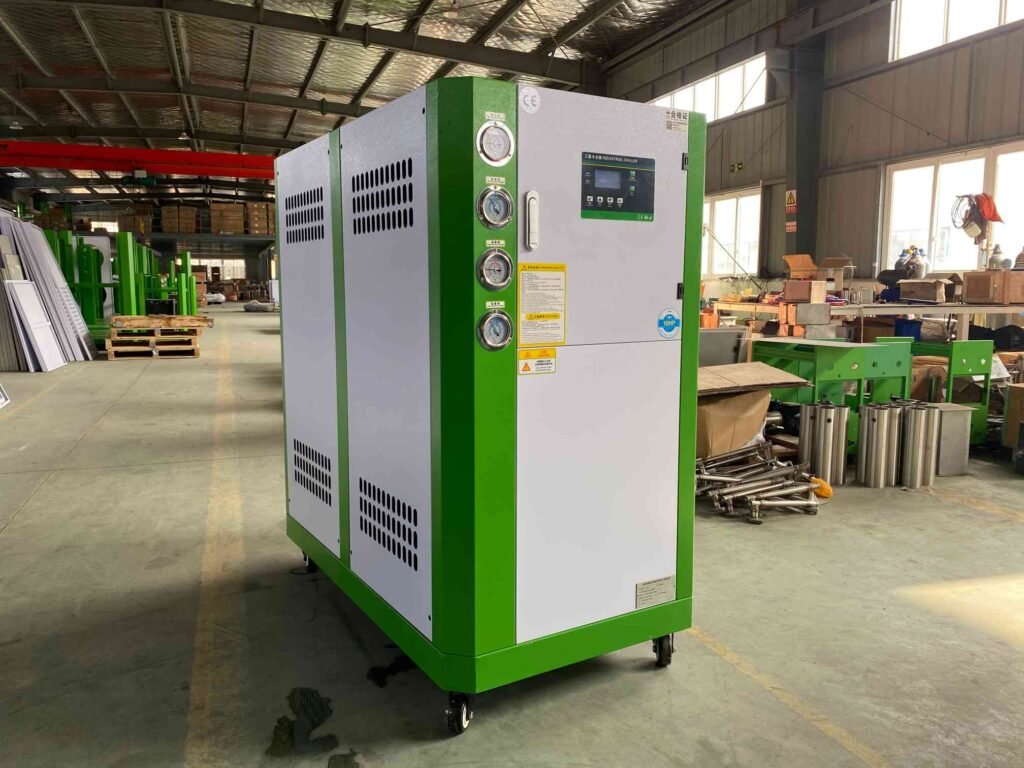
El principio básico
En esencia, una enfriadora traslada el calor de un lugar a otro. Eso es todo. Concepto sencillo, ejecución compleja.
Las enfriadoras industriales no crean frío exactamente. Eliminan el calor del agua de proceso o de otros fluidos y lo desechan a otro lugar. El fluido enfriado circula de nuevo hacia donde sea necesario enfriar: moldes de inyección, máquinas CNC, cortadoras láser o equipos de procesamiento de alimentos.
Piénsalo como un frigorífico. La misma idea básica, pero ampliada drásticamente. Las aplicaciones industriales exigen mucha más capacidad de refrigeración que mantener frescos los alimentos.
Explicación del ciclo de refrigeración
La mayoría de las enfriadoras industriales se basan en la refrigeración por compresión de vapor. Es una tecnología probada. Fiable. Suficientemente eficiente para aplicaciones comerciales.
Cuatro pasos esenciales
El ciclo se repite continuamente:
- Compresión - El compresor exprime el gas refrigerante, aumentando considerablemente su presión y temperatura
- Condensación - El refrigerante caliente fluye hacia el condensador, libera calor al aire o al agua y se convierte en líquido
- Expansión - El refrigerante líquido pasa a través de una válvula de expansión, la presión cae bruscamente y la temperatura se desploma
- Evaporación - El refrigerante frío entra en el evaporador, absorbe el calor del fluido del proceso y vuelve a convertirse en gas
Y de nuevo al compresor. Vuelta y vuelta.
El evaporador es donde se produce el enfriamiento real, donde el agua de proceso cede su calor al refrigerante frío. Todo lo demás en el ciclo existe para restablecer las condiciones para este intercambio de calor.
Componentes clave de las enfriadoras industriales
Comprender las piezas ayuda a solucionar problemas. Y al mantenimiento. Y saber cuándo algo suena mal.
Compresor
El corazón del sistema. Los compresores pueden ser de varios tipos:
- Compresores Scroll (unidades más pequeñas, funcionamiento más silencioso)
- Compresores de tornillo (capacidad media a grande, eficientes a cargas parciales)
- Compresores centrífugos (sistemas muy grandes, eficiencia excelente)
- Compresores alternativos (tecnología más antigua, pero aún común)
Cada tipo tiene sus ventajas y sus inconvenientes. Los niveles de ruido, las curvas de eficiencia y los requisitos de mantenimiento son diferentes.
Condensador
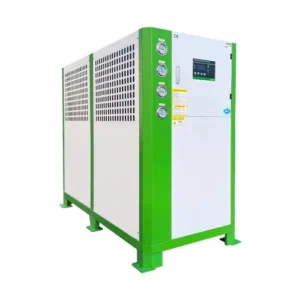
Dónde se expulsa el calor. El tipo de condensador determina en gran medida si se trata de una enfriadora refrigerada por aire o por agua.
| Tipo de condensador | Método de rechazo del calor | Aplicación típica |
|---|---|---|
| Refrigerado por aire | Los ventiladores soplan aire ambiente a través de las baterías | Instalaciones sin torres de refrigeración |
| Refrigeración por agua | El agua de la torre de refrigeración absorbe calor | Grandes instalaciones, mayor eficiencia |
| Evaporativo | Combinación de agua pulverizada y aire | Climas cálidos, limitaciones de espacio |
Los condensadores refrigerados por agua suelen ser más eficientes. Pero requieren torres de refrigeración, tratamiento del agua y más infraestructura. Las unidades refrigeradas por aire son más sencillas: sólo necesitan un flujo de aire adecuado alrededor de la unidad.
Evaporador
Los diseños de carcasa y tubos dominan las aplicaciones industriales. El agua de proceso fluye a través de los tubos mientras que el refrigerante los rodea (o viceversa). Los evaporadores de placas funcionan bien en las enfriadoras industriales más pequeñas: son compactos, eficientes y fáciles de limpiar.
Dispositivo de expansión
Suele ser una válvula de expansión térmica o una válvula de expansión electrónica. Controla el caudal de refrigerante que entra en el evaporador. Un control preciso afecta significativamente a la eficiencia global.
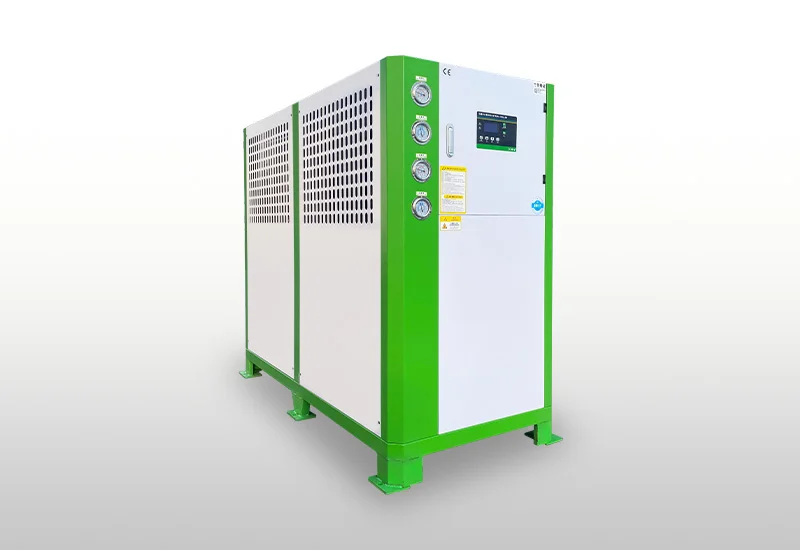
Sistemas refrigerados por aire frente a sistemas refrigerados por agua
Esta decisión da forma a toda la instalación.
Enfriadora por aire Ventajas
- Instalación más sencilla
- Menor carga de mantenimiento
- Sin consumo de agua
- Unidades autónomas
Refrigerador por agua Ventajas
- Mayor eficiencia
- Mayor vida útil de los equipos
- Mejor rendimiento en climas cálidos
- Posibilidad de instalación en interiores
Sinceramente, las condiciones del emplazamiento a menudo hacen que la elección sea obvia. ¿No hay espacio para torres de refrigeración? Pues refrigeración por aire. ¿Costes de energía astronómicos? La refrigeración por agua probablemente se amortiza antes.
Sistemas de control
Las enfriadoras industriales modernas son sorprendentemente inteligentes. Los controles por microprocesador supervisan docenas de parámetros continuamente.
Los valores clave supervisados incluyen:
- Temperatura de salida del agua refrigerada
- Presiones del refrigerante (lado alto y bajo)
- Consumo de amperios del compresor
- Presión y temperatura del aceite
- Temperatura de aproximación del condensador
Las alarmas se activan antes de que los problemas se vuelvan catastróficos. Algunos sistemas se conectan a redes de automatización de edificios, lo que permite la supervisión a distancia. Útil para instalaciones que funcionan durante la noche sin todo el personal.
Consideraciones sobre el tamaño
Las enfriadoras subdimensionadas luchan constantemente. Las unidades sobredimensionadas funcionan de forma excesivamente ineficiente y dañan los componentes.
El tamaño adecuado tiene en cuenta:
- Carga térmica total de todos los procesos
- Condiciones ambientales (hipótesis más desfavorables)
- Posibilidades de expansión en el futuro
- Requisitos de redundancia
Equivocarse sale caro. Las consultas a los proveedores de equipos tienen sentido en este caso: han visto lo que funciona y lo que no.
Mantenimiento
Las enfriadoras industriales recompensan la atención. Las máquinas descuidadas fallan antes. Consumen más energía. Producen temperaturas erráticas.
Las tareas habituales incluyen la comprobación de la carga de refrigerante, la limpieza de las baterías del condensador, la inspección de las conexiones eléctricas y la verificación de la calibración de los controles. Nada exótico, sólo constancia.

PREGUNTAS FRECUENTES
¿Cuánto suelen durar las enfriadoras industriales?
Con un mantenimiento adecuado, entre 15 y 20 años es razonable. Algunos duran más.
¿Qué refrigerantes utilizan las enfriadoras modernas?
En la actualidad son comunes los R-410A, R-134a y R-513A. Las unidades más antiguas pueden utilizar R-22.
¿Las enfriadoras también pueden calentar?
Sí: las enfriadoras con bomba de calor invierten el ciclo para proporcionar calefacción cuando es necesario.

 Spanish
  English
  Russian
  Portuguese
  French
  Arabic
  Japanese
  German