
There’s a reason why large facilities almost always use water cooled chillers. It’s not about complexity or first cost—it’s about efficiency. A well-designed water cooled industrial chiller can use significantly less electricity than an air cooled unit doing the same job. Over years of operation, that difference adds up to real money.
Having looked at energy bills from plants that switched from air cooled to water cooled, the savings are hard to ignore. But why exactly are they more efficient? The answer has to do with how heat gets rejected and how compressors work.
This is a look at the physics and engineering behind why a enfriadora industrial refrigerada por agua wins on efficiency.
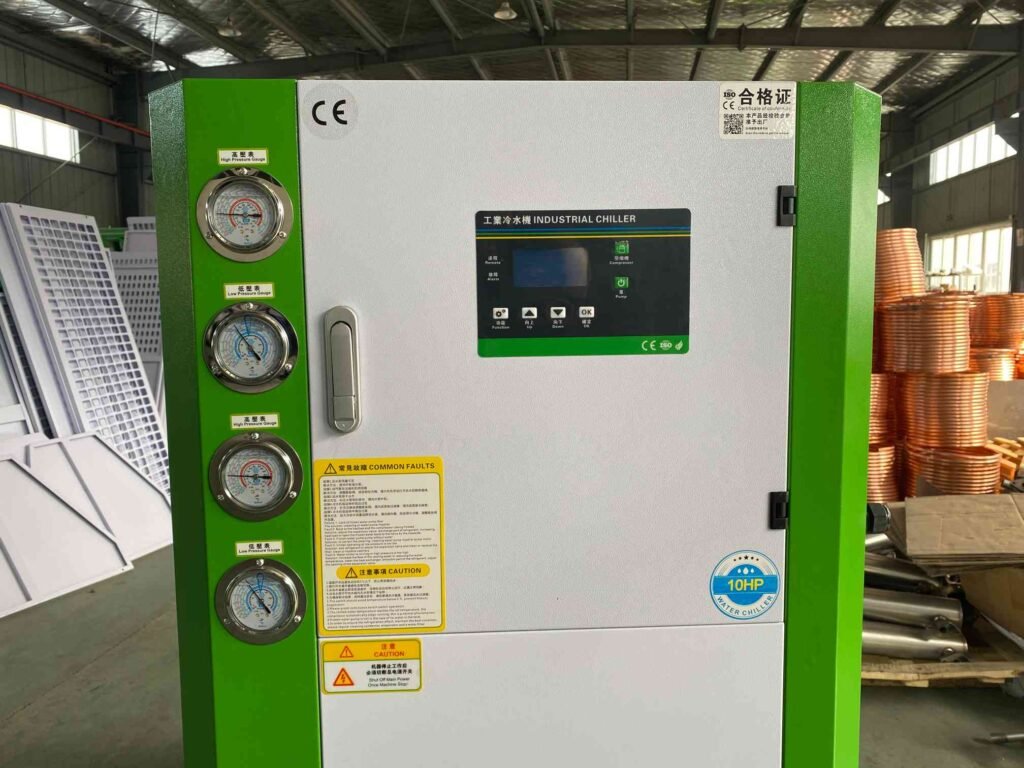
The Basic Physics Behind Water Cooled Industrial Chiller Efficiency
Efficiency in a chiller comes down to one thing: how hard the compressor has to work to move heat from the evaporator to the condenser. The lower the condenser temperature, the less work the compressor does.
Air vs. Water as a Heat Transfer Medium
Air is a terrible heat transfer fluid compared to water. It has low thermal conductivity and low specific heat. Water, by contrast, is excellent at carrying heat away. That’s why car radiators use water (or coolant) rather than just air.
A water cooled industrial chiller takes advantage of this. The condenser uses water—which is pumped from a cooling tower at maybe 85°F—to absorb heat from the refrigerant. An air cooled chiller uses ambient air, which on a hot summer day might be 95°F or higher, and air doesn’t absorb heat nearly as efficiently.
Wet Bulb vs. Dry Bulb Temperature
This is the key concept. An refrigerador por aire is limited by the dry bulb temperature—the actual air temperature. On a 100°F day, the air is 100°F. The chiller’s condensing temperature will be at least 100°F, usually higher.
A water cooled chiller, however, is limited by the wet bulb temperature—the temperature air would have if it were saturated with moisture. Cooling towers cool water by evaporation, and evaporation can bring water temperature down close to the wet bulb temperature. On a 100°F dry bulb day, the wet bulb might be only 75°F. That’s a 25°F lower condensing temperature.
Lower condensing temperature means lower compressor pressure ratio. Lower pressure ratio means less work. Less work means less electricity.
How Condensing Temperature Affects a Water Cooled Industrial Chiller
Let’s put some numbers to this. A typical water cooled industrial chiller might run with a condensing temperature of 95°F on a warm day. An air cooled chiller on the same day might run at 115°F condensing temperature.
| Parámetro | Refrigeración por agua | Refrigeración por aire | Difference |
|---|---|---|---|
| Condensing temperature | 95°F (35°C) | 115°F (46°C) | 20°F higher |
| Condensing pressure (R134a) | ~120 psig | ~170 psig | 50 psig higher |
| Compressor power (relative) | 1.0 | 1.25–1.35 | 25–35% more energy |
That 20°F difference in condensing temperature translates directly into higher compressor power. The air cooled chiller works harder to push refrigerant against higher pressure.
The Impact of Hot Weather
The efficiency gap widens as outside temperature rises. On a mild 75°F day, an air cooled chiller might be reasonably efficient. On a 105°F day, it struggles. Condensing pressure climbs. The compressor works harder. The chiller might even derate—producing less cooling capacity while using more power.
A water cooled industrial chiller, by contrast, sees only a small efficiency drop on hot days. The wet bulb temperature rises much less than the dry bulb. On a 105°F dry bulb day, the wet bulb might be 78°F. The cooling tower still delivers water around 85°F. The chiller barely notices the heat wave.
From an observational standpoint, this is why data centers and hospitals—facilities that need reliable cooling even during heat waves—almost always choose water cooled.
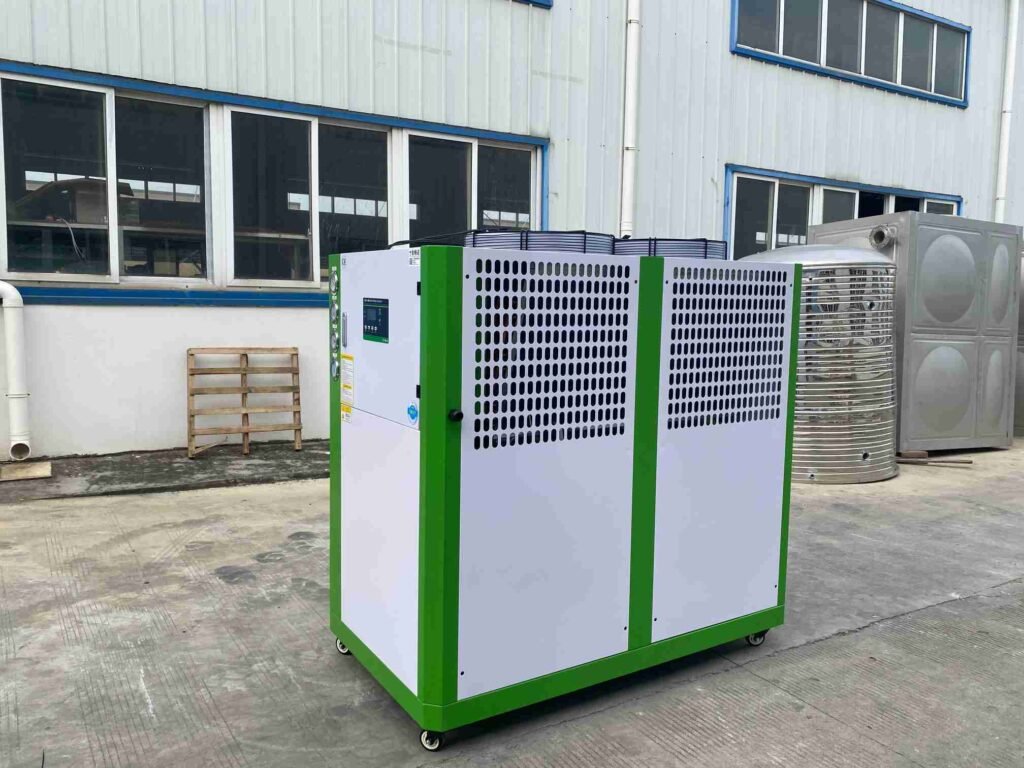
Part-Load Efficiency and the Water Cooled Advantage
Chillers rarely run at full load. Most of the time, they’re at 40–70% of capacity. How a chiller performs at partial load matters more than its full-load efficiency.
How Water Cooled Chillers Handle Part Load
A water cooled industrial chiller with a variable speed drive on the compressor and variable speed tower fans can maintain excellent efficiency down to 20–30% load. The condenser water temperature can be reset upward at low loads to save tower fan energy, but the chiller still operates at low condensing pressure.
Air cooled chillers struggle more at part load. The condenser fans cycle on and off or run at fixed speeds. The chiller may need to run the fans harder than necessary just to maintain minimum condensing pressure, especially in cool weather.
Integrated Part Load Value (IPLV)
The industry measures part-load efficiency with IPLV (Integrated Part Load Value). A good water cooled industrial chiller might have an IPLV of 0.35–0.45 kW/ton. An air cooled chiller of similar size might be 0.70–0.85 kW/ton. The water cooled unit uses roughly half the electricity at typical operating conditions.
Real-World Energy Savings
Let’s run an example. A 300-ton chiller running 4,000 hours per year (typical for a manufacturing facility or data center). Electricity at $0.12 per kWh.
| Tipo de enfriador | Full Load kW/ton | IPLV kW/ton | Annual kWh | Annual Cost |
|---|---|---|---|---|
| Water cooled | 0.55 | 0.45 | 540,000 | $64,800 |
| Air cooled | 0.85 | 0.75 | 900,000 | $108,000 |
The water cooled chiller saves $43,200 per year in electricity. Over a 20-year lifespan, that’s $864,000 in avoided energy costs. That pays for a lot of cooling tower maintenance.
The First Cost Trade-Off
Water cooled chillers cost more upfront. The chiller itself is more expensive. Add a cooling tower, condenser water pumps, piping, and water treatment. The installed cost of a water cooled system might be 30–50% higher than an air cooled system.
But the payback period is often short. In the example above, if the water cooled system costs $150,000 more upfront, the payback is about 3.5 years from energy savings alone. After that, it’s pure savings.
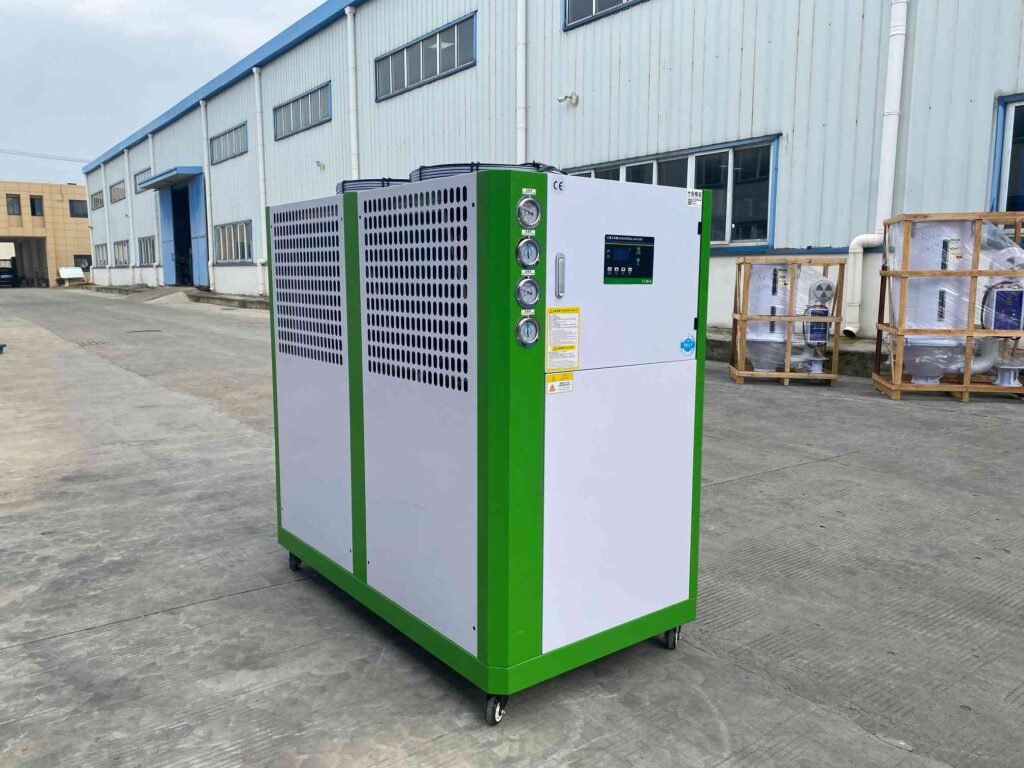
Other Factors That Affect Efficiency
Beyond the basic thermodynamics, a few other things contribute to the efficiency advantage of a water cooled industrial chiller.
Tipo de compresor
Water cooled chillers often use centrifugal or screw compressors, which are inherently more efficient at large sizes than the scroll compressors common in air cooled units. Centrifugal compressors have no rubbing parts and can achieve very low kW/ton, especially at large capacities.
Heat Exchanger Design
Water cooled chillers use shell-and-tube heat exchangers. These have excellent heat transfer coefficients—much better than the finned tube coils in air cooled units. That means smaller temperature differences are needed to transfer heat, which further reduces compressor work.
Free Cooling Potential
In cool weather, some water cooled systems can use the cooling tower directly to provide chilled water without running the chiller compressor. This is called free cooling. A bypass arrangement sends tower water through a heat exchanger (or directly to the load) when the wet bulb temperature is low enough. Air cooled chillers can’t do this—they must run compressors any time cooling is needed.
Is Water Cooled Always More Efficient?
Almost always, but there are exceptions.
A water cooled industrial chiller requires pumps to move condenser water. Those pumps use electricity.
A cooling tower uses fans. Water treatment uses chemicals and sometimes electricity. These auxiliary loads reduce the net efficiency advantage slightly.
In very cold climates, an air cooled chiller can take advantage of low ambient temperatures to achieve good efficiency. On a 40°F day, an air cooled chiller might perform nearly as well as a water cooled unit.
But over a full year in most climates, water cooled wins. The gap is largest in hot, humid climates where air cooled performance suffers most.
The Bottom Line for Your Facility
Choosing a chiller involves more than just efficiency. Water availability, maintenance capabilities, space, noise, and first cost all matter.
But if energy efficiency is the priority—and for many facilities, it is—a water cooled industrial chiller is the clear choice. The physics is clear. The numbers add up. And over the life of the equipment, the savings are substantial.
Una enfriadora industrial refrigerada por agua es uno de los componentes de un sistema más amplio. sistema de refrigeración industrial that includes cooling towers, pumps, piping, and controls. All of those pieces need to work together for the system to achieve its potential efficiency. But the chiller itself—when properly selected and maintained—delivers performance that air cooled simply can’t match.
If you want to know more about water cooled industrial chiller, please read ¿Qué es una enfriadora industrial por agua? Cómo funciona.
PREGUNTAS FRECUENTES
¿Cuánto más eficaz es una enfriadora por agua que por aire?
A plena carga en climas cálidos, una enfriadora refrigerada por agua suele ser 25-40% más eficiente. A carga parcial, la diferencia puede ser de 40-50% o más.
¿El consumo de agua de una torre de refrigeración anula el ahorro de energía?
Water has a cost, but it’s usually much lower than the electricity savings. In most regions, the water used by a cooling tower costs a fraction of the electricity saved.
¿Puedo convertir un sistema refrigerado por aire existente en uno refrigerado por agua?
Not practically. The chiller itself would need to be replaced. However, adding a cooling tower and new water cooled chiller while keeping the existing air cooled unit as backup is sometimes done.

 Spanish
  English
  Russian
  Portuguese
  French
  Arabic
  Japanese
  German