
Walking into a high-capacity manufacturing facility, the first thing one notices isn’t necessarily the complexity of the robotic arms or the speed of the conveyor belts—it is the heat. Heat is the inevitable byproduct of progress, and managing that heat is precisely where 工業用冷水機 come into play. Without these robust systems, modern production would essentially grind to a halt under the weight of its own thermal energy. It is quite fascinating, really, how something so foundational often goes unnoticed until a breakdown occurs.
Understanding Industrial Water Chiller Machines and Their Vital Role
To truly grasp the landscape of thermal management, one must first look at what industrial water chiller machines actually do. At their core, these are refrigeration systems used to lower the temperature of machinery, industrial process fluids, or even entire building environments by removing heat from the system and transferring it elsewhere.
There is a certain rhythmic reliability to an industrial chiller that works well. It isn’t just about blowing cold air; it’s about a sophisticated thermodynamic cycle involving evaporation, compression, and condensation. In many ways, the industrial water chiller is the “circulatory system” of a factory, pumping chilled water to where it is most needed to prevent sensitive components from melting or warping. It’s worth noting that the choice of a chiller often dictates the overall efficiency of a plant’s energy consumption, which is why understanding the specific types is more than just a technical exercise—it’s a financial one.
The Mechanics of Heat Transfer
Most systems operate on a vapor-compression or absorption cycle. While the science is standard, the application varies wildly. One might observe that in a plastic injection molding setup, the chiller must be incredibly precise to ensure the plastic sets correctly, whereas, in a large-scale data center, the priority might be sheer volume and consistent uptime.
The Primary Categories: Air-Cooled vs. Water-Cooled
When categorizing these machines, the most common fork in the road is how the machine gets rid of the heat it has collected. This is generally divided into two main camps: air-cooled and water-cooled systems.
Air-Cooled Industrial Water Coolers
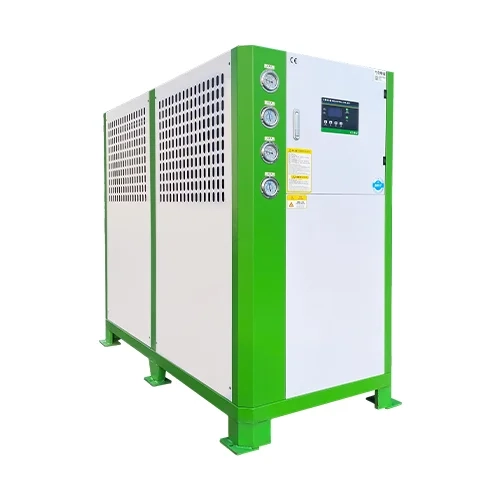
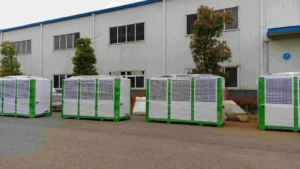
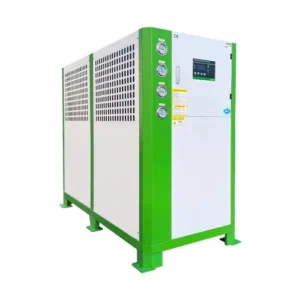
Air-cooled industrial water coolers utilize ambient air to reject heat. These units are typically equipped with fans that blow air across a condenser coil. One might find these systems installed outdoors, perhaps on a rooftop or a parking lot, because they require a significant amount of fresh air to function effectively.
- 長所だ: Lower installation costs, no need for a cooling tower, and generally easier to maintain.
- Cons: They can be quite loud due to the fans, and their efficiency drops significantly when the ambient outdoor temperature is very high.
Water-Cooled Systems
On the other hand, water-cooled units are often preferred for large-scale operations where efficiency is the top priority. These systems require a cooling tower and a constant supply of water to whisk the heat away from the condenser. It’s a bit more complex to set up, but the thermal conductivity of water is far superior to air.
Diversification by Compressor Technology
Beyond how they cool themselves, industrial water chiller machines are often defined by the “heart” of the system: the compressor. This is where the heavy lifting happens, and different technologies suit different load requirements.
The Power of the Water-cooled Screw Chiller
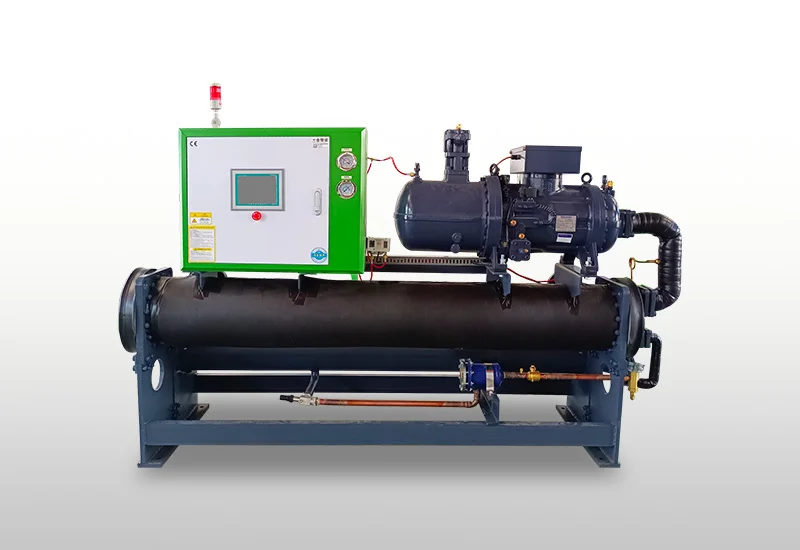
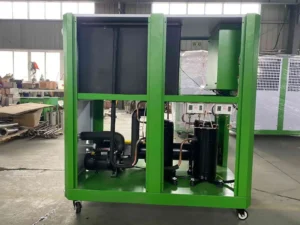
For mid-to-large cooling capacities, the 水冷式スクリュー冷凍機 is frequently the go-to choice. These machines use two interlocking rotating screws to compress the refrigerant. The beauty of this design lies in its simplicity—fewer moving parts than a reciprocating engine means there is generally less that can go wrong.
One might observe that a Water-cooled screw chiller operates with a much smoother “hum” compared to the rhythmic thumping of older piston-style compressors. This makes them ideal for environments where vibration needs to be kept to a minimum. They are also incredibly adept at “part-load” operation, meaning they can turn their power down when the factory isn’t running at full tilt, saving a massive amount of electricity.
Centrifugal and Reciprocating Options
For truly massive requirements—think district cooling or massive chemical plants—centrifugal chillers are the giants of the industry. They use high-speed impellers to compress refrigerant. Conversely, for smaller, more “localized” cooling needs, reciprocating (piston-style) compressors are still used, though they are slowly being phased out by more efficient scroll compressors in the lower tonnage ranges.
Industry Applications: Where These Machines Live
It is quite easy to underestimate the ubiquity of the industrial water chiller. From the food we eat to the medicine we take, these machines are everywhere.
- Plastics Industry: Cooling the hot plastic in molds so it takes the correct shape quickly.
- Medical Imaging: Keeping MRI and CT scanners from overheating during operation.
- Food and Beverage: Rapidly cooling milk or carbonating soft drinks.
- Metal Finishing: Controlling the temperature of plating tanks to ensure a smooth finish.
Walking into a high-capacity manufacturing facility, the first thing one notices isn’t necessarily the complexity of the robotic arms or the speed of the conveyor belts—it is the heat. Heat is the inevitable byproduct of progress, and managing that heat is precisely where industrial water chiller machines come into play. Without these robust systems, modern production would essentially grind to a halt under the weight of its own thermal energy. It is quite fascinating, really, how something so foundational often goes unnoticed until a breakdown occurs.
Maintenance Tips for Long-Lasting Industrial Water Chiller Machines
A chiller is a significant investment, often costing tens or even hundreds of thousands of dollars. Therefore, maintenance isn’t just a “good idea”—it’s a necessity. One might notice that the most common cause of chiller failure isn’t a catastrophic mechanical break, but rather a slow decline caused by neglect.
- Keep the Tubes Clean: In water-cooled systems, scale and algae can build up in the condenser tubes, acting as an insulator and forcing the machine to work harder.
- Check Refrigerant Levels: A small leak might not stop the machine immediately, but it will cause the compressor to run hot and eventually burn out.
- Analyze the Oil: Much like a car, the oil in an 工業用冷凍機 tells a story. Regular oil analysis can detect moisture or metal shavings long before they cause a total system failure.
- Monitor Ambient Conditions: For air-cooled units, ensuring that the intake fins aren’t clogged with dust or debris is a simple task that pays huge dividends in efficiency.
Actually, it is quite common for facilities to skip these basic steps, only to wonder why their energy bills are skyrocketing. A well-maintained industrial water chiller can easily outlive its expected lifespan, while a neglected one might struggle to reach its tenth birthday.
Selecting the Right Equipment for Your Facility
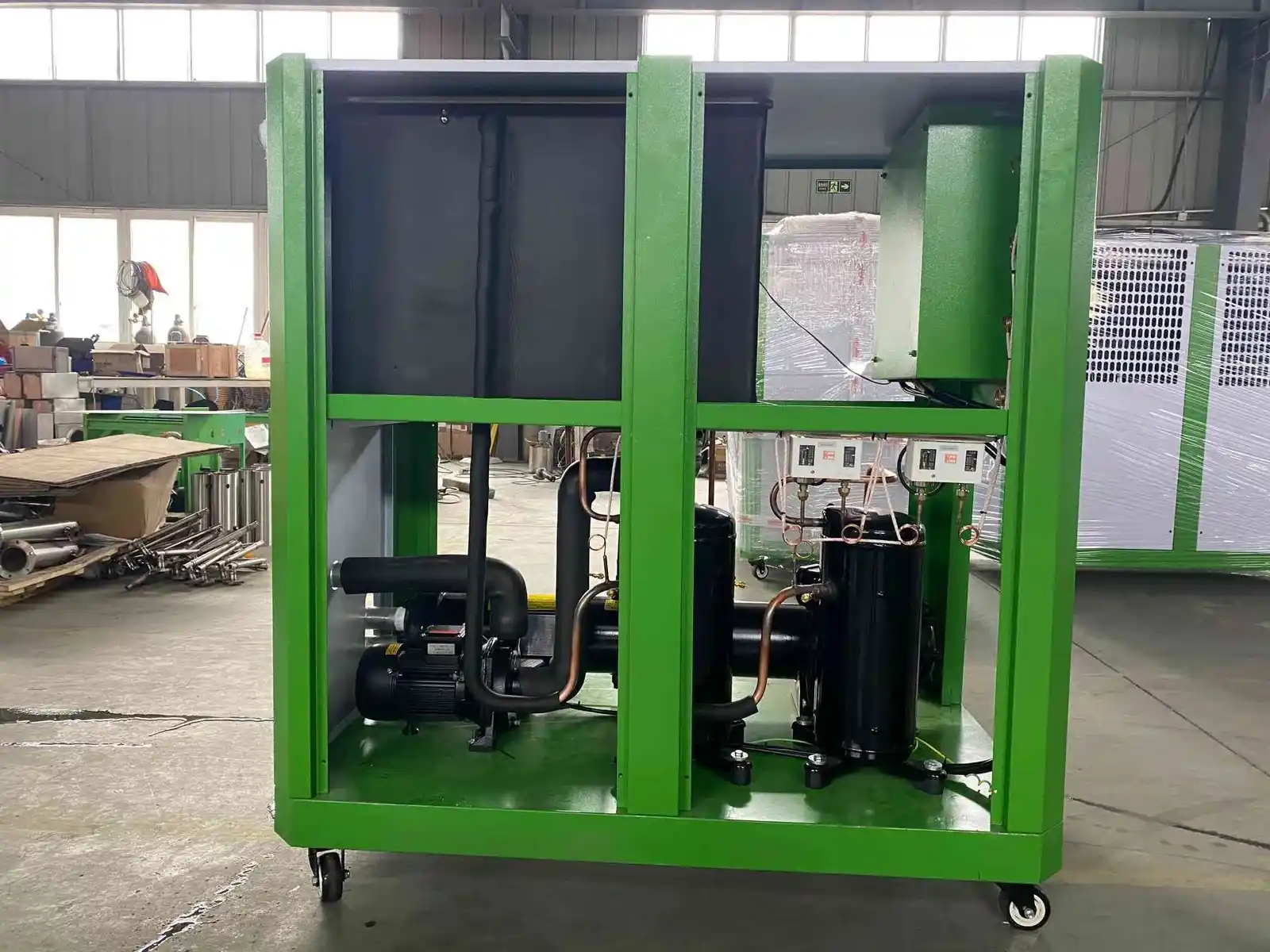
Choosing between various industrial water chiller machines requires a balance of upfront cost, long-term operational expenses, and spatial constraints. If space is at a premium and water is expensive, an air-cooled model is likely the winner. However, if the facility has the infrastructure for a cooling tower and operates 24/7, the efficiency gains of a water-cooled model—especially a Water-cooled screw chiller—usually justify the higher initial price tag.
It’s also worth considering the “future-proofing” aspect. As environmental regulations tighten regarding refrigerants, looking for machines that utilize low-GWP (Global Warming Potential) gases is a smart move for any forward-thinking operation.
Summary Comparison of Industrial Water Chiller Machines
| チラータイプ | 冷却方法 | Ideal Application | Primary Advantage |
|---|---|---|---|
| 空冷式チラー | Ambient Air & Fans | Outdoor installations with limited water access | Low maintenance and simple setup |
| 水冷式チラー | Cooling Tower & Water | Large-scale plants and indoor mechanical rooms | Maximum energy efficiency and longevity |
| Water-cooled Screw Chiller | Rotating Twin Screws | Mid-to-large consistent industrial loads | Excellent part-load efficiency and reliability |
| Centrifugal Chiller | High-speed Impellers | Massive scale (District cooling, Large chemical plants) | Highest capacity for high-tonnage needs |
| Scroll/Reciprocating | Orbital or Piston Compression | Small-scale or localized process cooling | Compact size and precise thermal control |
よくあるご質問
工業用冷水機は、加熱と冷却の両方に同時に使用できますか?
標準的な産業用冷水機は熱を除去するように設計されていますが、「熱回収チラー」として知られる特定のカテゴリーでは、コンデンサー側からの排熱を回収して再利用することができます。その熱を大気中に放出する代わりに、家庭用温水の予熱や、施設内の他の場所の暖房に使用することができ、工場全体の熱効率を大幅に高めることができます。.
アプローチ温度」は工業用冷水機の性能にどのような影響を与えるのか?
アプローチ温度とは、熱交換器から出る流体の温度と内部の冷媒の温度との差を指します。アプローチ温度が “タイト ”または低いことは、工業用冷水機の熱伝達プロセスが非常に効率的であることを示します。この差が時間とともに広がり始めた場合、熱交換器の表面が汚れてきているか、流量が設計仕様から逸脱していることを示す主な指標となります。.
化学処理のような腐食性の高い環境に特化したチラーはありますか?
そう、塩水、酸、海水を含む環境では、熱交換器の標準的な銅管はすぐに破損してしまう。このようなシナリオでは、メーカーは「耐腐食性」ビルドを利用し、多くの場合、チタンまたは高品位ステンレス鋼コンポーネントを採用している。さらに、塩分や酸性の空気が産業用チラーの構造を蝕むのを防ぐため、外部キャビネットを特殊なエポキシ塗料でコーティングすることもある。.

 Japanese
  English
  Spanish
  Russian
  Portuguese
  French
  Arabic
  German